
Occupational Health for SMEs: The 2026 Comprehensive Guide
Most small business owners treat health and safety as a box-ticking exercise for physical hazards, but they're leaving their biggest asset entirely unprotected. It's understandable why you might feel overwhelmed by the distinction between general safety and clinical occupational health services for SMEs. You likely worry about the potential for HSE intervention or the spiralling costs of long-term sickness absence, yet finding a clear starting point often feels impossible.
This guide provides a pragmatic roadmap to protecting your workforce, showing you how to safeguard your team without the corporate price tag. We'll break down your legal obligations, explore cost-effective wellbeing strategies, and show you how a proactive approach reduces staff turnover while ensuring total compliance. By shifting from reactive medical care to a strategic investment in business resilience, you can protect your bottom line. We've designed this approach to be a safe pair of hands for enterprises that need technical authority delivered with common-sense practicality.
Table of Contents
What are Occupational Health Services for SMEs?
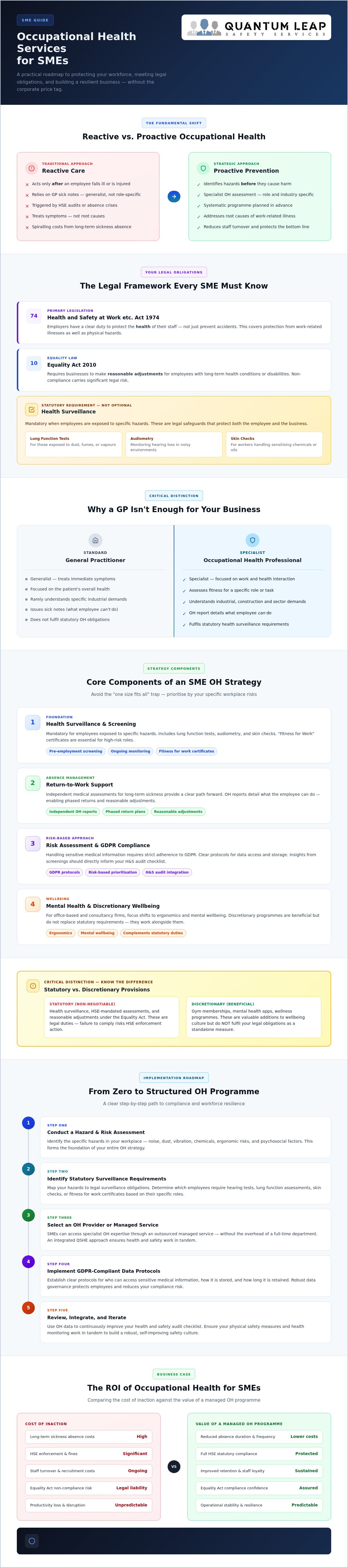
Occupational health is a specialist branch of medicine focused on the relationship between work and health. It's about more than just managing sick notes. It involves a systematic approach to ensuring that employees remain both physically and mentally fit for their specific roles. For many businesses, occupational health services for SMEs represent the difference between a resilient workforce and one plagued by recurring absence.
Effective OH is proactive. It focuses on prevention by identifying workplace hazards before they cause harm. This is distinct from reactive medical care, which only begins once an employee is already unwell. Whilst larger corporations often have in-house teams, SMEs frequently overlook these services until a crisis occurs. This might be a sudden HSE audit or a complex long-term absence case that threatens operational stability.
It's vital to distinguish between statutory health surveillance and discretionary wellness programmes. Statutory requirements are non-negotiable legal duties. Discretionary programmes, such as gym memberships or mental health apps, are beneficial but they don't fulfill your legal obligations under safety regulations.
The Legal Framework: HSE and the Equality Act 2010
Under the Health and Safety at Work etc. Act 1974, employers have a clear duty to protect the health of their staff. This isn't limited to preventing accidents. It includes protecting them from work-related illnesses. The Equality Act 2010 adds another layer of responsibility, requiring businesses to make reasonable adjustments for employees with long-term health conditions or disabilities. Health Surveillance is a statutory requirement for employees exposed to specific risks such as noise, vibration, or hazardous substances.
Why Traditional GP Services Aren’t Enough for Businesses
A local GP is a generalist. They provide excellent primary care but rarely understand the specific physical demands of a construction site or a high-risk renewable energy project. They focus on the patient's immediate symptoms rather than their fitness for a specific industrial task. Occupational health professionals bridge this gap by assessing whether an employee can safely perform their duties. By utilising outsourced QSHE managed services, SMEs can access this technical expertise without the overhead of a full-time department. This ensures that medical advice is always grounded in the practical realities of your specific industry.
Core Components of an SME Occupational Health Strategy
Building a successful health strategy for smaller organisations avoids the "one size fits all" trap. Instead, it prioritises resources based on the specific risks present in your workplace. For a consultancy or office-based firm, the focus might be on ergonomics and mental wellbeing. For those in construction or renewables, the requirements are more clinical and rigorous. For many businesses, occupational health services for SMEs represent the difference between a resilient workforce and one plagued by recurring absence.
Handling sensitive medical information requires strict adherence to GDPR. Your organisation must have clear protocols for who accesses this data and how it's stored. When managed correctly, the insights gained from these screenings should directly inform your health and safety audit checklist. This ensures that your physical safety measures and health monitoring work in tandem to create a robust safety culture.
Workplace Health Surveillance and Screening
Mandatory health surveillance is required when employees are exposed to specific hazards that could lead to identifiable diseases. In high-risk environments, this includes several key assessments:
Lung function tests for those exposed to dust, fumes, or vapours.
Audiometry to monitor hearing loss in noisy environments.
Skin checks for workers handling sensitising chemicals or oils.
These aren't optional extras. They are legal safeguards that protect both the employee and the business. In sectors like construction, "Fitness for Work" certificates are essential for high-risk roles such as plant operation or working at height. Pre-employment screening also plays a vital role. By assessing a candidate's health before they start, you ensure they're physically capable of the role, reducing the risk of future injury or claims.
Absence Management and Return-to-Work Support
When an employee is on long-term sickness, an independent medical assessment provides a clear path forward. Unlike a standard GP note, an OH report details what the employee can do, rather than just what they're restricted from doing. This allows managers to implement phased returns to work, which might include temporary light duties or reduced hours. This methodical approach helps staff reintegrate safely and prevents the cycle of re-injury.
Mental health support is equally critical. Stress-related absenteeism is a significant cost for modern enterprises. Providing access to professional support early can prevent a short-term issue from becoming a long-term absence. Partnering with a provider to manage these occupational health services for SMEs ensures you have a safe pair of hands guiding your compliance journey.
The Business Case: ROI of Occupational Health for SMEs
Investing in occupational health services for SMEs is a strategic decision that directly influences the bottom line. Whilst some directors view health surveillance as a sunk cost, the financial reality of employee absence suggests otherwise. Sickness absence doesn't just halt production; it creates administrative burdens, temporary recruitment costs, and project delays. A managed approach acts as a safe pair of hands, shielding the business from the financial shocks of HSE fines or employee tribunals.
Beyond immediate cost savings, a robust health strategy demonstrates operational excellence. This commitment to quality is a core requirement for those seeking ISO 9001 certification. By integrating health monitoring into your quality management system, you prove to clients and stakeholders that your enterprise is disciplined, compliant, and sustainable.
Reducing Sickness Absence and Presenteeism
Presenteeism occurs when employees attend work whilst unwell, resulting in significantly reduced productivity and an increased risk of workplace accidents. This hidden cost often exceeds the expense of total absence. Early intervention in musculoskeletal (MSK) issues is a prime example of proactive ROI. For instance, identifying early signs of back strain in a technician allows for immediate ergonomic adjustments or physiotherapy referrals. This simple step prevents a minor ache from developing into a long-term disability claim that could cost the business thousands in lost hours and potential litigation.
Attracting and Retaining Top Talent
In a competitive labour market, particularly within high-risk sectors like renewables, being an "Employer of Choice" is essential. Providing occupational health services for SMEs serves as a powerful recruitment tool. It signals to potential hires that their wellbeing is a priority, not an afterthought. This culture of care reduces staff turnover, which is often one of the highest hidden costs for smaller firms. When workers feel supported through regular wellness monitoring and health support, their loyalty to the business increases. This stability ensures that your most experienced team members remain healthy and productive for the long term, preserving vital institutional knowledge and reducing the need for constant, expensive retraining cycles.
How to Implement Occupational Health: A Step-by-Step Guide
Transitioning from no formal provision to a structured programme doesn't require a corporate-scale department. For most enterprises, success lies in a methodical approach that integrates with existing compliance structures, such as your fire safety management plans. By aligning health monitoring with your wider safety culture, you create a seamless system that protects both your staff and your legal standing. Employee engagement is vital during this rollout. When workers understand that these measures are designed to protect their long-term wellbeing, rather than monitor their performance, they're far more likely to participate fully.
Step 1: Conduct a Health Risk Audit
Your first priority is to identify where your specific health risks lie. This isn't just about physical hazards. It's a pragmatic review of how your work environment impacts your team. A thorough audit should include:
Hazard Identification: Pinpoint exposure to dust, chemicals, excessive noise, or high-vibration tools.
Data Review: Analyse your existing accident and absence records. Look for patterns, such as recurring musculoskeletal issues or stress-related leave in specific departments.
Staff Consultation: Speak with your employees. They often have the best insight into the daily physical or mental strains of their roles.
This data-driven foundation ensures your occupational health services for SMEs are targeted where they'll provide the most value, rather than being a generic, expensive checklist.
Step 2: Define Service Requirements and Choose a Partner
Once you've identified your risks, you must decide how to manage them. Smaller firms often struggle to choose between ad-hoc assessments and a managed service retainer. Whilst ad-hoc services might seem cheaper initially, a retainer model provides continuous access to competent advice, which is essential for maintaining total compliance. This "safe pair of hands" approach ensures you aren't scrambling for help when a crisis occurs.
When selecting a provider, industry experience is non-negotiable. If you operate in renewables or construction, your partner must understand the technical demands of those sectors. Verify the qualifications of their clinicians and ensure the consultancy has a reputation for straightforward, common-sense advice. They should act as an extension of your team, helping you navigate complex regulations with ease.
If you're ready to secure your workforce and simplify your compliance journey, explore our Occupational Health Services to find a pragmatic solution tailored to your business needs.
Why SMEs Choose the QLSS Integrated OH Approach
Managing multiple consultants often leads to fragmented data and conflicting advice. By selecting a single partner for your QSHE and occupational health services for SMEs, you ensure that medical insights directly inform your safety protocols. Quantum Leap Safety Services (QLSS) acts as your "competent person" under UK safety regulations, providing a level of technical authority that standalone medical clinics often lack. We don't just provide a report; we help you integrate that advice into your daily operations. This joined-up approach creates a safe pair of hands for your business, ensuring that your health surveillance and safety audits work in perfect synchronisation.
Pragmatic, Cost-Effective Compliance
Our "Business Total Compliance" philosophy is built on the reality of SME operations. We understand that you don't have the unlimited budgets of multi-national corporations. Instead of pushing generic, high-cost packages, we tailor our services to the specific scale of your organisation. This pragmatic approach avoids unnecessary bureaucracy and focuses on what actually protects your staff and your legal standing. By choosing a managed service retainer, you gain ongoing support rather than just one-off inspections. This ensures your compliance remains current as regulations evolve, providing long-term stability and predictable costs for your business.
Expertise in High-Risk and Regulated Sectors
High-risk environments require specialised knowledge that generalist providers cannot offer. Whether you're managing construction sites or complex health and safety for renewable projects, the OH requirements are rigorous. We understand the nuances of wind farm safety and industrial health surveillance, from managing vibration exposure to ensuring workers are fit for remote environments. Beyond the clinical assessments, we take the administrative burden off your desk by managing mandatory safety training records. This ensures your team is always qualified and your documentation is ready for any audit. If you're looking for a methodical partner to secure your workforce, enquire about our Occupational Health support for your business today.
Securing Your Workforce for 2026 and Beyond
Building a resilient business requires more than just meeting minimum safety standards; it demands a proactive commitment to your team's physical and mental wellbeing. By implementing occupational health services for SMEs, you move from a reactive stance to a strategic model that reduces absence and improves staff retention. A risk-based approach ensures your resources are focused exactly where they're needed, avoiding the burden of unnecessary bureaucracy whilst maintaining total compliance with UK safety regulations.
Quantum Leap Safety Services has acted as a safe pair of hands for enterprises across the country since 2012. Our pragmatic QSHE experts provide national UK coverage, offering retainer-based managed services that bridge the gap between medical expertise and daily operational safety. Whether you're managing complex construction projects or renewable energy sites, we provide the steady guidance needed to navigate intricate legal duties with confidence.
Don't wait for a crisis to protect your most valuable assets. Contact Quantum Leap Safety Services for a pragmatic approach to SME Occupational Health. Taking this step today ensures your business remains stable, compliant, and ready for future growth.
Frequently Asked Questions
Are occupational health services mandatory for all SMEs?
Occupational health services are mandatory if your risk assessment identifies specific health hazards that require statutory health surveillance. This includes exposure to noise, vibration, or hazardous substances. Even without these specific risks, all employers have a legal duty under the Health and Safety at Work etc. Act 1974 to protect employee health. Implementing occupational health services for SMEs ensures you meet these obligations whilst protecting your business from potential HSE intervention.
How much do occupational health services typically cost for a small business?
The cost of these services depends on your specific risk profile and whether you choose a managed service retainer or ad-hoc assessments. A retainer model often provides better value for smaller firms as it ensures continuous access to competent advice. Whilst specific fees vary, the investment is typically much lower than the cost of a single long-term sickness absence or a legal tribunal. We focus on providing a pragmatic, cost-effective approach tailored to your scale.
What is the difference between occupational health and health and safety?
Health and safety focuses on the workplace environment and the prevention of accidents through hazard control. Occupational health is a clinical discipline that focuses on the individual employee and how work affects their physical and mental wellbeing. Whilst health and safety might involve installing guards on machinery, occupational health assesses if the operator is physically fit to use that equipment without long-term health implications. Both are essential components of total compliance.
Can occupational health help with employee mental health and stress?
Yes, occupational health professionals are specifically trained to assess and manage workplace stress and mental health conditions. They provide independent clinical assessments that help managers understand an employee's capacity for work. By identifying early warning signs, these services can suggest adjustments to workloads or environments. This proactive support prevents minor stress from escalating into long-term absence, which is a significant driver of high staff turnover in smaller organisations.
What happens during a workplace health surveillance appointment?
A typical health surveillance appointment involves a series of clinical tests tailored to the specific risks identified in your workplace. This might include audiometry for noise exposure, lung function tests for dust, or skin examinations for chemical handling. The clinician also reviews health questionnaires to track changes over time. Following the appointment, the employer receives a "Fitness for Work" certificate, which confirms the employee's suitability for their role without disclosing private medical details.
Do I need occupational health if my employees work from home?
Remote workers are still subject to the same health and safety legislation as those in a physical office or site. You still have a duty of care to manage their mental wellbeing and ensure their home setup doesn't cause musculoskeletal issues. Occupational health services for SMEs can include remote DSE assessments and mental health check-ins. These services help prevent the isolation and physical strain that often lead to decreased productivity amongst home-based teams.
How does occupational health integrate with ISO 45001 standards?
ISO 45001 requires organisations to proactively manage their occupational health and safety performance. Occupational health is a critical part of this international standard, specifically regarding the monitoring of health trends and the prevention of ill health. An integrated OH strategy provides the documented evidence required during an ISO audit. It proves that your business isn't just reacting to injuries but is systematically protecting the long-term health of its workforce.
Can an OH provider help me manage a difficult return-to-work case?
Managing a complex return-to-work case is one of the most valuable aspects of a managed OH service. An independent clinician provides a clear, professional report detailing what an employee can safely do. This removes the guesswork for managers and helps define reasonable adjustments under the Equality Act 2010. By following a structured, phased return plan, you reduce the risk of a relapse and ensure the employee reintegrates into the team effectively.


Comments