
2026 Health and Safety Guide for Construction Sites
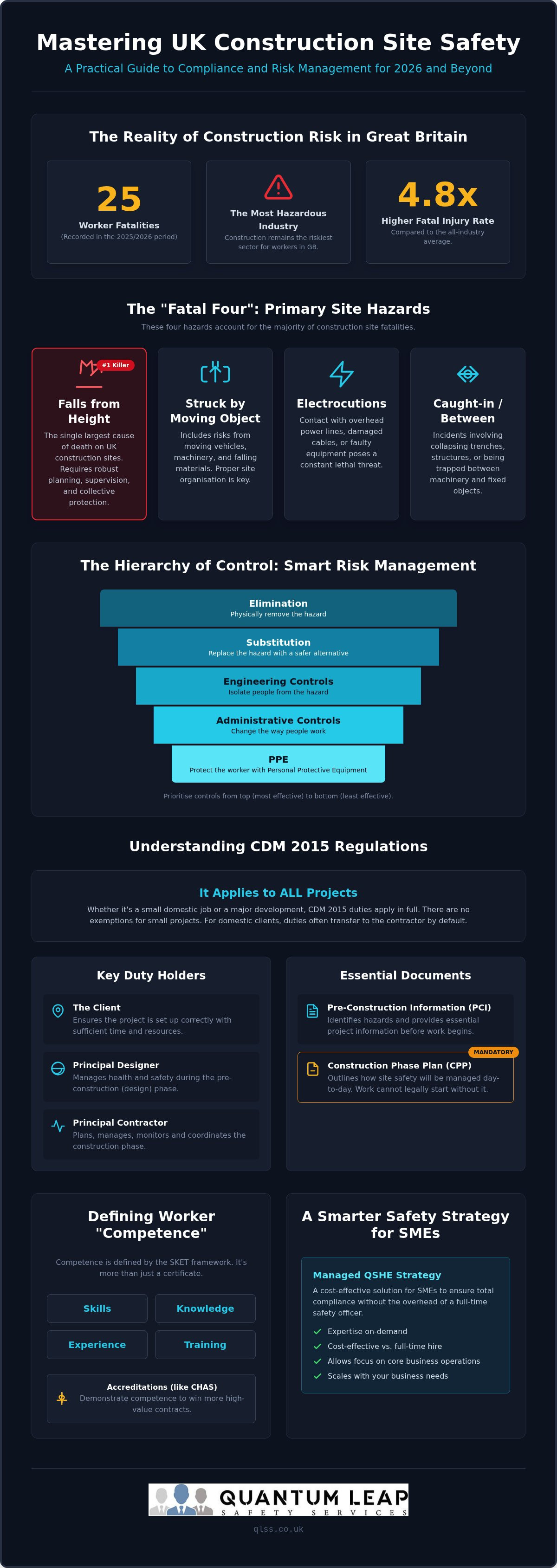
With 25 worker fatalities recorded across the 2025/2026 period, the construction sector remains the most hazardous industry in Great Britain. You likely feel the weight of this responsibility every time you step onto a site, balancing the need for high productivity with the strict requirements of health and safety for construction sites. It's understandable if the fear of HSE prosecutions or the complexity of the Building Safety Act 2022 feels overwhelming whilst you're trying to keep a project on track.
This guide provides a pragmatic roadmap to help SME builders and site managers maintain total compliance without getting lost in the paperwork. We'll show you how to turn safety from a hurdle into a strategic asset that protects your team and your reputation. We'll preview the upcoming Building Safety Levy arriving in October 2026, explain the latest trauma-informed first aid standards, and outline how achieving accreditations like CHAS can help you win more high-value contracts.
Table of Contents
Understanding the Legal Framework: CDM 2015 and Beyond
The Construction (Design and Management) Regulations 2015, commonly known as CDM 2015, serve as the primary legal framework governing health and safety for construction sites across the United Kingdom. These regulations don't just apply to skyscrapers or major infrastructure projects. Whether you're undertaking a minor shop fit-out or a large-scale residential development, the law demands a structured approach to risk management. As we move through 2026, regulatory scrutiny has intensified. SMEs are increasingly moving away from informal safety management towards professional, managed compliance models to avoid the mounting costs of HSE intervention fees and potential prosecutions. Central to this framework is the appointment of a Principal Contractor and a Principal Designer, roles that carry significant legal weight in ensuring the project is planned and executed safely.
The Three Pillars of Construction Compliance
Every project requires clearly defined duty holders who understand their specific responsibilities. The Client must ensure the project is set up correctly; the Principal Designer manages risks during the design phase; and the Principal Contractor plans and monitors the actual build. A solid Construction Site Safety Overview reveals that effective communication between these parties is the most critical factor in preventing workplace accidents. This communication is anchored by two essential documents. First, the Pre-Construction Information (PCI) pack identifies hazards before work begins. Second, the Construction Phase Plan (CPP) is a mandatory document that outlines exactly how you will manage site safety on a day-to-day basis. Failing to produce a CPP before work starts is a direct breach of the law.
CDM Duties for Smaller Contractors
It's a common misconception that small jobs are exempt from the law. Even if a project is non-notifiable, meaning it lasts fewer than 30 working days or involves fewer than 500 person days, CDM duties still apply in full. For domestic clients, these responsibilities often transfer to the contractor by default. Managing this documentation doesn't have to be an administrative burden. Simple, organised systems for risk assessments and method statements ensure you're protected if an inspector visits. For firms looking to scale without the overhead of a full-time hire, outsourced QSHE managed services provide a reliable way to maintain high standards of health and safety for construction sites whilst focusing on site productivity and project delivery.
Identifying and Managing High-Risk Site Hazards
Managing risks on a live project requires a disciplined approach to the most common causes of workplace injury. In the construction sector, the "Fatal Four", consisting of falls from height, being struck by moving objects, electrocutions, and caught-in-between incidents, account for the majority of site fatalities. According to 2025/2026 data, the fatal injury rate in construction remains approximately 4.8 times the all-industry average, with falls from height being the single largest cause of death. Site managers should follow the hierarchy of control to manage these effectively. This methodology prioritises Elimination of the hazard entirely, followed by Substitution, Engineering Controls, Administrative Controls, and finally, PPE as a last resort. For instance, substituting a hazardous chemical for a safer alternative is always more effective than simply providing a mask.
Effective management of these hazards is a core requirement of the CDM 2015 Regulations. Relying on a static risk assessment isn't enough; conditions on a site change daily as the build progresses. Conducting regular site safety inspections UK wide ensures that emerging risks, such as a damaged guardrail or an unsecured excavation, are identified and rectified immediately. If you need support in establishing these routines, our Construction QSHE Services can provide the necessary expert oversight to keep your project compliant.
Work at Height: The Constant Risk
Working at height is an unavoidable reality for most projects. Compliance with the Work at Height Regulations 2005 requires that all work is properly planned, supervised, and carried out by competent people. This involves more than just erecting scaffolding or providing ladders. You must ensure that edge protection is robust and that all operatives hold the correct IPAF or PASMA certifications for the equipment they use. By prioritising collective protection measures like guardrails over personal ones like harnesses, you create a safer environment for the entire team and reduce the likelihood of a fall-related incident.
Health Surveillance and Respiratory Risks
Modern health and safety for construction sites now places an equal emphasis on long-term occupational health. Respirable Crystalline Silica (RCS), or silica dust, is a significant threat during cutting and grinding operations. You can control this risk through engineering solutions like on-tool water suppression or vacuum extraction. Where RPE is required, Face Fit testing is a legal necessity to ensure the mask provides a proper seal. Implementing a structured health surveillance programme through professional occupational health services ensures your workforce remains fit for work, protecting them from debilitating conditions like silicosis or noise-induced hearing loss. This proactive stance on health and safety for construction sites helps maintain a reliable, healthy workforce for years to come.
Essential Site Infrastructure and Safety Signage
Establishing a secure physical environment is the first step in managing health and safety for construction sites. This begins with a robust site perimeter. CDM 2015 mandates that every project has a clearly defined boundary to prevent unauthorised access, particularly by children or vulnerable members of the public. High-quality hoarding or fencing serves as a vital barrier against the inherent risks of a live build. Whilst branding on hoarding is common, its primary function remains the protection of the community from hazards like falling debris, deep excavations, and heavy plant movement.
Legal compliance also extends to the provision of mandatory welfare facilities. You cannot operate a compliant site without providing adequate toilets, washing facilities with hot and cold running water, and clean areas for rest and meals. These facilities must be easily accessible to all operatives and maintained in a hygienic condition throughout the project. Providing these basic necessities is not just a matter of worker dignity; it's a fundamental legal requirement that site inspectors check as a priority during any unannounced visit.
Communication on site is reinforced through standardised safety signage. These signs are categorised by colour and shape to ensure immediate understanding. Mandatory signs (blue circles) dictate required behaviours like wearing hard hats. Prohibitory signs (red circles with a diagonal bar) forbid specific actions. Warning signs (yellow triangles) alert workers to hazards like overhead cables. Finally, emergency signs (green rectangles) identify escape routes and first aid points. A well-signposted site reduces confusion and ensures that critical safety information is available at a glance.
Effective traffic management is equally critical for maintaining health and safety for construction sites. Vehicles and pedestrians are a dangerous mix in confined spaces. You should develop a clear traffic management plan that separates moving plant from walking routes through the use of physical barriers, designated crossing points, and clear markings. Minimising the need for reversing and ensuring all drivers have a clear line of sight helps reduce the risk of collisions, which remain a leading cause of serious injury in the industry.
Public Safety and Site Security
Sites located near schools or residential centres require heightened security measures. Unauthorised access after hours is a significant liability risk. Beyond physical hoarding, implementing CCTV and perimeter alarms provides a proactive layer of protection. You should also ensure that all hazardous materials and equipment, such as ladders or flammable substances, are securely locked away at the end of each shift to prevent accidents involving trespassers.
Fire Safety on Construction Sites
Temporary structures and the presence of flammable materials make fire safety a constant concern. You must develop a robust fire safety management plan that accounts for evolving site conditions. This includes maintaining clear, unobstructed escape routes and ensuring an adequate number of serviced fire extinguishers are positioned at key locations. Regular fire drills and clear emergency procedures ensure that every person on site knows exactly how to respond if an incident occurs.
Competence, Training, and Professional Accreditations
Under CDM 2015, competence is defined by a specific blend of Skills, Knowledge, Experience, and Training, often referred to as SKET. It's not enough to simply have a worker on site; they must be demonstrably capable of performing their specific tasks safely. CSCS cards remain the industry standard for verifying these qualifications at the gate, providing a quick visual check for site managers. However, for SME builders, maintaining a structured training matrix is the only way to track compliance across a fluctuating workforce. This live document ensures that no one's certifications lapse, protecting the business from the legal fallout of an accident involving an operative whose training had expired.
Winning Work with CHAS and SafeContractor
Safety accreditations like CHAS or Alcumus SafeContractor serve as a powerful badge of trust in the UK market. For many SMEs, these SSIP (Safety Schemes in Procurement) certifications are the key to bypassing the exhaustive health and safety sections of Pre-Qualification Questionnaires (PQQs). By proving your standards meet a recognised national benchmark, you can compete more effectively with larger Tier 1 contractors for lucrative commercial projects and government tenders. Managing these complex applications can be incredibly time-consuming, which is why many firms use a professional consultant to handle the evidence gathering and submission process. This ensures a "right first time" approach that secures the accreditation without distracting your team from daily site operations.
Mandatory Safety Training for Site Managers
Leadership on site requires specific, high-level certifications to ensure health and safety for construction sites is managed correctly. Site managers typically require the five-day SMSTS (Site Management Safety Training Scheme) course, whilst supervisors may only need the two-day SSSTS (Site Supervisor Safety Training Scheme) version. Beyond these core qualifications, you must ensure that first aid and fire marshal training remains current and site-appropriate. The HSE recommends at least one person trained in First Aid at Work (FAW) for every 50 workers on high-risk sites, with an increasing focus in 2026 on trauma-informed training. Tracking these refresher dates whilst maintaining project momentum is a significant challenge, but it's essential for maintaining total site compliance.
To simplify your compliance journey and secure the accreditations needed to grow, explore our Safety Packages & Accreditations today.
Implementing a Managed QSHE Strategy for Construction
Adopting a proactive approach to health and safety for construction sites is a strategic decision that pays dividends in both risk reduction and operational efficiency. For many SME builders, the overhead of a full-time safety officer is difficult to justify. A managed service retainer provides a pragmatic alternative, offering access to high-level technical authority for a fraction of the cost of a permanent hire. This model allows your business to scale its safety support in line with project demand, ensuring you always have a "safe pair of hands" to manage complex regulatory requirements. By integrating ISO 9001 and ISO 45001 into your core management systems, you create a disciplined framework where quality and safety are treated as inseparable business values.
Independent site audits are a vital component of this managed strategy. Internal teams often develop "site blindness" over time, overlooking minor hazards that have become part of the daily landscape. An external auditor identifies these blind spots before an HSE inspector or the Building Safety Regulator arrives on site. These inspections provide an objective snapshot of your compliance levels, allowing you to rectify issues in a controlled manner. This methodical process ensures that your health and safety for construction sites remains robust, even as project conditions evolve and new subcontractors join the build.
The Role of the Outsourced Safety Consultant
An outsourced consultant acts as a dedicated partner, providing competent advice whenever site emergencies or logistical challenges arise. This relationship ensures your documentation is constantly updated to reflect 2026 legislative shifts, such as the implementation of the Building Safety Levy. Rather than just identifying problems, a professional consultant works with your site managers to find practical, common-sense solutions that keep the project moving whilst maintaining total legal compliance. This hands-on support is particularly valuable during high-pressure phases of a build where safety protocols might otherwise be sidelined.
Safety in Renewable Energy Projects
As the industry shifts towards green infrastructure, safety management must adapt to the unique risks of wind, solar, and battery storage projects. These sites often involve high-voltage electrical works, remote locations, and complex lifting operations that require specialised oversight. Managing a multi-contractor environment in these settings demands a highly organised QSHE strategy to prevent communication breakdowns. Conducting a thorough health and safety audit for renewable projects is essential for identifying the specific hazards associated with renewable energy infrastructure. Positioning safety as a core value in these projects not only protects your workforce but also enhances your reputation with developers who prioritise high environmental and safety standards.
Building a Safer, More Profitable Future on Site
Mastering health and safety for construction sites is no longer just a regulatory obligation; it's a competitive advantage for the modern SME. By moving beyond basic compliance and embracing a structured QSHE strategy, you protect your most valuable assets: your people and your reputation. Whether you're managing the high-voltage risks of a renewable energy project or ensuring site welfare meets current standards, a methodical approach ensures project stability and long-term business growth.
You don't have to navigate these intricate legal requirements alone. Professional QSHE managed services provide the technical authority and expert support you need to achieve critical accreditations like CHAS and Alcumus SafeContractor. This outsourced model offers a "safe pair of hands" to manage site-specific logistical challenges whilst you focus on delivering high-quality builds. As the industry moves towards more complex green infrastructure, having a dedicated partner ensures your safety protocols remain robust and effective.
Secure your site with Quantum Leap Safety Services and turn your safety protocols into a strategic asset for 2026 and beyond. We're here to help you build with confidence.
Frequently Asked Questions
What are the main health and safety responsibilities for a construction site manager?
A site manager's primary duty is the day-to-day coordination of site safety. This includes ensuring all workers receive a site induction, verifying competence through CSCS cards, and maintaining the Construction Phase Plan. You must monitor work activities to ensure they follow agreed method statements and risk assessments. Effective health and safety for construction sites also relies on the manager providing clear leadership, managing traffic routes, and ensuring that welfare facilities remain clean and accessible throughout the project.
Does CDM 2015 apply to small domestic construction projects?
Yes, CDM 2015 applies to all construction work in the UK, including minor domestic projects like extensions or loft conversions. Whilst domestic clients don't have the same duties as commercial ones, their responsibilities usually transfer to the contractor or principal contractor. You must still create a Construction Phase Plan and ensure the site is managed safely. For small builders, this means the legal framework for health and safety for construction sites is always in effect, regardless of project scale.
How often should health and safety audits be carried out on-site?
The frequency of site audits depends on the complexity and risk level of the project. For most active construction sites, a formal independent audit should be conducted at least monthly to identify emerging hazards. High-risk phases, such as demolition or complex structural work, may require more frequent inspections. Regular auditing helps identify "site blindness" where internal teams overlook routine risks. These inspections ensure your management systems remain effective and that you're prepared for unannounced visits from the HSE.
What is the difference between an SMSTS and an SSSTS qualification?
The SMSTS (Site Management Safety Training Scheme) is a five-day course designed for project managers and site agents who have overall responsibility for site safety. In contrast, the SSSTS (Site Supervisor Safety Training Scheme) is a two-day course tailored for team leaders and foremen. Whilst both cover legal responsibilities under CDM 2015, the SMSTS provides a deeper dive into planning and implementing safety systems. Every site must have a competent person with the appropriate level of training for their role.
How can a small builder achieve CHAS accreditation quickly?
Achieving CHAS accreditation quickly requires having well-organised safety documentation, including risk assessments, training records, and evidence of previous safe working practices. Small builders often find the application process time-consuming due to the volume of evidence required. Using a professional consultant to manage your application can significantly speed up the process. They ensure your submission is "right first time" by identifying gaps in your compliance before the assessment, helping you secure the accreditation needed to win commercial work.
What welfare facilities are mandatory on a UK construction site?
Under Schedule 2 of CDM 2015, you must provide adequate toilets, washing facilities with hot and cold running water, and clean rest areas. These facilities must include a way to heat food and boil water, along with a supply of wholesome drinking water. Washing facilities must be located near toilets and changing rooms; they should include soap and towels. Maintaining these standards is a fundamental legal requirement. Failing to provide basic welfare is one of the most common reasons for HSE enforcement action.
What happens if a construction site fails an HSE inspection?
If a site fails an inspection, the HSE inspector may issue a Notification of Contravention, which triggers Fees for Intervention (FFI) charges. For more serious breaches, they may issue an Improvement Notice, giving you a deadline to fix specific issues, or a Prohibition Notice, which stops work immediately. In cases of significant negligence or accidents, the HSE can pursue criminal prosecutions, leading to substantial fines or imprisonment. Maintaining total compliance is the only way to protect your business from these severe financial and legal consequences.
How do I manage health and safety for a renewable energy installation?
Managing safety for renewable energy projects, such as solar farms or wind turbines, requires addressing specialised risks like high-voltage electricity and complex lifting operations. You must coordinate multiple specialist contractors and ensure that site-specific hazards are clearly communicated during inductions. Implementing a managed QSHE strategy allows for continuous oversight and professional auditing tailored to these high-tech environments. This approach ensures that your safety standards match the high expectations of developers and helps you navigate the technical complexities of green infrastructure builds.


Comments