
Fire Safety Management: A Guide for UK Businesses 2026
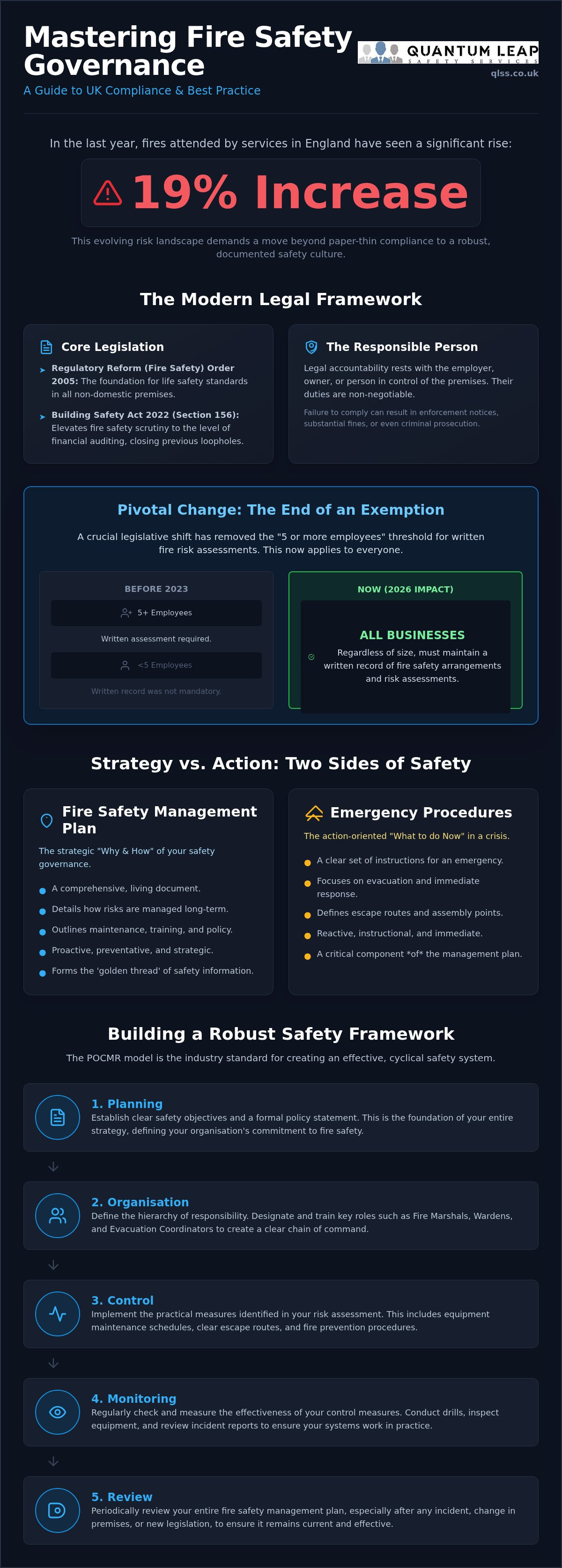
With fires attended by services in England rising by 19% in the last year, a paper-thin approach to compliance is no longer a viable business strategy. It's understandable if you feel overwhelmed by the sheer volume of documentation required to protect your premises and your people. Many SMEs find it difficult to distinguish between a standard risk assessment and the robust fire safety management plans now expected by the Building Safety Regulator. The pressure to keep up with the Fire Safety (Residential Evacuation Plans) (England) Regulations 2025 and updated British Standards can make safety feel like a burden rather than a benefit.
We recognise that your time is best spent running your organisation, not untangling legal jargon. This guide will help you master the complexities of fire safety governance and ensure your business remains compliant with the latest UK legislation. You'll gain a clear understanding of your legal duties and a structured framework for your safety systems. By the end of this article, you'll have the practical knowledge needed to face any fire safety audit with absolute confidence, knowing your business is a safe pair of hands.
Table of Contents
The Legal Framework for Fire Safety Management Plans in 2026
A strategic fire safety management plan serves as the operational blueprint for your business's safety governance. It's far more than a simple checklist; it's a comprehensive document that details how your organisation manages fire risks, maintains equipment, and trains staff. The primary legislation governing these requirements remains the Regulatory Reform (Fire Safety) Order 2005, which sets the standard for life safety across all non-domestic premises in England and Wales.
The enforcement landscape in 2026 is defined by the full integration of Section 156 of the Building Safety Act 2022. This legislation closed previous loopholes, ensuring that fire safety is treated with the same level of scrutiny as financial auditing. Compliance now requires a proactive approach to documentation that leaves no room for ambiguity during a Fire and Rescue Service inspection. You must move beyond a "tick-box" exercise to a living document that reflects the true state of your premises.
The Role of the Responsible Person
Legal accountability rests with the Responsible Person, who is usually the employer, building owner, or the person in control of the premises. This individual carries the weight of ensuring the building is safe for employees, visitors, and even those in the immediate vicinity. In multi-occupied buildings, the law demands a high level of coordination between different Responsible Persons to ensure that individual fire safety principles align across the entire structure.
The Responsible Person is the individual or entity legally charged with ensuring the premises meet all safety standards, including the mandatory recording of risk assessments and the implementation of robust evacuation strategies as of 2026. Neglecting these duties can result in severe legal consequences. Authorities have the power to issue enforcement notices, substantial fines, or pursue criminal prosecution if fire safety management plans are found to be insufficient or non-existent.
2023 Legislative Shifts and Their 2026 Impact
A pivotal change that businesses must respect is the removal of the "5 or more employees" threshold. Previously, smaller enterprises were exempt from the requirement to record their fire risk assessments in writing. This is no longer the case. Every business, even those with a single employee, must now maintain a written record of their fire safety arrangements and assessments. This ensures a consistent standard of safety across the UK's entire commercial landscape.
Transparency is now the expected norm. You're required to share fire safety information with other residents and businesses in your building to foster a collective safety culture. This record-sharing is a fundamental part of the modern "golden thread" of safety information, designed to prevent the communication failures that have historically led to tragedy. Keeping your documentation digital and accessible is often the most pragmatic way to meet these sharing obligations whilst ensuring you're ready for any spot check.
The Core Components of an Effective Fire Safety Strategy
Effective fire safety management plans represent a strategic governance framework designed to protect lives and ensure business continuity. While many organisations rely on generic templates, true compliance requires a bespoke approach tailored to your specific premises. Your plan should act as the functional guide for the hazards identified in your risk assessment, transforming static observations into an active, managed process that's accessible to all relevant stakeholders. It's the bridge between knowing a risk exists and having a disciplined system to control it.
The industry standard for this framework is the POCMR model, which stands for Planning, Organisation, Control, Monitoring, and Review. By following this structure, you ensure that every aspect of fire safety is accounted for, from initial policy setting to long-term oversight. You can find further details on prevention strategies within the latest UK government fire safety guidance to ensure your documentation aligns with national expectations and best practice.
Planning and Organisation
Success begins with clear safety objectives and a formal policy statement. This document should outline your commitment to safety and define the hierarchy of responsibility within the business. It's essential to designate specific roles such as Fire Marshals, Wardens, and Evacuation Coordinators. These individuals need more than just a title; they require clear, written instructions on their duties during both normal operations and emergencies. Organising a safety culture means ensuring every staff member understands that fire prevention is a collective responsibility, not just the task of a single department.
Control, Monitoring, and Review
Control measures are the practical steps you take to mitigate risks in high-hazard areas, such as server rooms or commercial kitchens. Monitoring involves a disciplined schedule of inspections and equipment testing to ensure these controls remain effective. This isn't a one-time task. You must conduct regular audits of your fire doors, alarms, and emergency lighting to maintain a safe environment. Finally, the review phase is critical. You should revisit your plan at least once a year or immediately following any significant changes to the building layout or a post-incident analysis. This constant cycle of improvement keeps your business resilient and compliant.
Maintaining this level of detail can be time-consuming for busy managers. If you're looking for a steady partner to oversee these requirements, our Fire Safety Management services provide a pragmatic solution for long-term compliance and peace of mind.
Distinguishing Between Management Plans and Emergency Procedures
It's common for business owners to conflate strategic governance with tactical response. Whilst both are essential, they serve entirely different purposes within your overall fire safety management plans. Understanding this distinction is the key to moving beyond basic compliance and achieving true operational resilience. A management plan is your overarching strategy; the emergency plan is the specific set of actions taken when the alarm sounds. You shouldn't view them as interchangeable documents.
You need both elements to satisfy legal inspectors and protect your workforce. Think of the emergency procedures as a functional subset of the broader management plan. If the management plan is the handbook for how you run the building safely every day, the emergency plan is the specific chapter on what happens during a crisis. Using consistent terminology across both ensures that staff don't get confused when high-pressure situations arise. This clarity is vital for maintaining a "safe pair of hands" approach to corporate responsibility.
The Operational Emergency Plan
This document is entirely action-oriented. It focuses on the immediate physical response to a fire, detailing evacuation routes, assembly points, and the activation of warning systems. It must include specific provisions for vulnerable persons through Personal Emergency Evacuation Plans (PEEPs), ensuring that everyone can exit the building safely regardless of their physical ability. These plans are now under increased scrutiny following the latest legislative updates in 2026.
Instructions should be clear, punchy, and easy to follow under stress. They cover how to contact emergency services and, where safe to do so, how to use equipment to tackle small fires. This tactical response relies heavily on the findings of your initial fire safety risk assessment, which identifies the specific hazards that an emergency plan must address. Without this groundwork, your emergency response remains guesswork.
The Governance Management Plan
In contrast, the governance side focuses on long-term stability and evidence. It houses your safety policies, maintenance schedules for fire doors and alarms, and comprehensive training records. This is where you document your strategy for safety investment and infrastructure improvements. It provides the proof that your safety systems are monitored and reviewed rather than just installed and forgotten.
For many SMEs, this strategic approach aligns perfectly with broader quality standards. Integrating your safety governance with ISO 9001 implementation services UK ensures that fire safety isn't an isolated silo but a core part of your business's quality assurance framework. This methodical approach ensures that your fire safety management plans remain active, compliant, and ready for any external audit.
Implementation and Maintenance: Keeping Your Premises Compliant
Effective fire safety management plans are not static documents meant to gather dust on a shelf. They require active integration into the daily operations of your business to create a genuine safety culture. Compliance is a continuous process of maintenance, testing, and education. When your safety documentation becomes a lived experience for your staff, you significantly reduce the risk of human error during an emergency. This transition from paper to practice is what distinguishes a resilient business from one that is merely compliant on paper.
You must also account for the dynamic nature of modern commerce. Building layouts change, new equipment is installed, and staff turnover occurs. Each of these variables requires an immediate update to your safety procedures. Regular reviews ensure that your governance remains accurate and that your physical controls, such as fire doors and detection systems, are fully functional. This disciplined approach prevents small maintenance gaps from becoming major legal liabilities.
Training and Competence
Staff training is the cornerstone of any functional safety strategy. Every new employee should receive fire safety induction training on their first day, followed by annual refresher sessions for the entire workforce. This isn't just about showing people where the exits are; it's about ensuring they understand the specific risks associated with their environment. Specialist training is required for Fire Marshals and the Responsible Person to ensure they can lead effectively during an evacuation.
Practical fire drills serve as the ultimate test of your training's effectiveness. You should conduct these at least twice a year to identify bottlenecks in your evacuation routes or confusion regarding assembly points. Observing how your team reacts under the simulated pressure of a drill provides invaluable data for your annual review. It allows you to refine your procedures based on real-world behaviour rather than theoretical assumptions.
Record Keeping and Audits
A robust fire logbook is your primary evidence of compliance. Whether you prefer a traditional physical folder or a modern digital system, your records must be accurate, up to date, and easily accessible. During a fire safety audit, an enforcement officer will look for a clear trail of maintenance, including weekly alarm tests, monthly emergency lighting checks, and annual extinguisher servicing. Digital logbooks are becoming the preferred choice for SMEs as they offer automated reminders and secure cloud storage, reducing the risk of lost documentation.
Your business must retain all fire safety records for a minimum period of five years to demonstrate a consistent history of compliance to regulatory bodies. This historical data is vital for proving that your safety governance is a long-term commitment. If you're concerned that your current records might not stand up to professional scrutiny, our Audit & Inspection Services provide the expert oversight needed to ensure you remain fully protected.
Professional Fire Safety Management with Quantum Leap Safety Services
Quantum Leap Safety Services (QLSS) acts as a dedicated partner for SMEs that require technical authority without the overhead of an internal safety department. We understand that fire safety management plans are often viewed as complex administrative hurdles. Our role is to simplify these requirements, providing a "safe pair of hands" that allows you to focus on your core operations. By adopting a pragmatic approach, we ensure your compliance measures are functional and cost-conscious, supporting your business's growth rather than creating unnecessary friction.
Our expertise extends beyond standard office environments into high-risk sectors such as construction and renewable energy projects. These industries face unique challenges that generic safety templates cannot address. We specialise in tailoring governance frameworks to meet the specific demands of your site, ensuring that every risk is accounted for and every legal obligation is met with precision. This methodical focus ensures that your safety systems are robust enough to withstand the most rigorous external scrutiny.
Managed Fire Safety Solutions
A managed service retainer offers the most reliable route to continuous compliance. Instead of treating safety as a yearly panic, our retainer model provides ongoing support with documentation updates and regulatory advice. This ensures your fire safety management plans remain accurate as your business evolves. You gain direct access to competent persons who can answer complex safety queries, providing clarity and stability when you need it most.
Regular site inspections are a core part of this service. We don't just write the plan; we help you implement it. By conducting periodic checks, we verify that your physical controls and staff behaviours align with your written policy. This methodical oversight provides peace of mind, knowing that your premises are always prepared for an unannounced inspection or a formal audit. It's a disciplined approach that prioritises long-term stability over short-term fixes.
Expert Fire Risk Assessments and Audits
For businesses seeking project-based support, we offer fixed-price fire risk assessments that deliver a comprehensive overview of your safety status. These assessments result in a detailed action plan, prioritising the steps needed to close any compliance gaps quickly and efficiently. We focus on clear, service-oriented advice that highlights dependability and operational efficiency, ensuring you get the best value from your safety investment.
What sets QLSS apart is our ability to integrate fire safety with your broader QSHE and ISO management systems. We bridge the gap between different regulatory requirements, ensuring that your fire safety strategy works in harmony with your quality and environmental standards. This holistic view of corporate responsibility transforms safety from an isolated task into a core component of your business's total compliance solution, providing a seamless transition between different service areas.
Securing Your Business for a Safer Future
Maintaining a safe premises in 2026 requires more than a simple risk assessment; it demands a disciplined approach to governance. You've seen that effective fire safety management plans must be bespoke, active documents that evolve alongside your business operations. By distinguishing between strategic governance and tactical emergency actions, you ensure your organisation is prepared for both regulatory audits and real-world crises.
Quantum Leap Safety Services has been a trusted partner for UK SMEs since 2012. We provide comprehensive managed services and pragmatic, common-sense safety solutions that fit your specific industry needs. Whether you're navigating new legislation or integrating safety with ISO standards, we offer the technical authority required to protect your workforce. Ensure your business is fully compliant; contact Quantum Leap Safety Services today. Taking these steps now creates a stable foundation for your future growth and ensures your business remains a safe pair of hands.
Frequently Asked Questions
Is a fire safety management plan a legal requirement for small businesses?
Yes, a fire safety management plan is a legal requirement for all UK businesses regardless of their size. Following the 2023 legislative updates, the previous exemptions for smaller firms have been removed. Every employer must now document their safety arrangements to satisfy Fire and Rescue Service inspectors. This ensures that even the smallest organisations have a clear strategy for protecting their staff and visitors from fire hazards.
What is the difference between a fire risk assessment and a fire safety management plan?
A fire risk assessment identifies specific hazards and the people at risk, whilst fire safety management plans detail the strategic governance used to control those risks. The assessment is a snapshot of current dangers, but the plan is a long-term roadmap for maintenance, training, and policy enforcement. You need both documents to demonstrate a comprehensive and compliant safety culture within your organisation.
How often should a fire safety management plan be reviewed?
You should review your plan at least once every twelve months to ensure it remains accurate. Immediate reviews are also mandatory if you make significant changes to the building layout, install new high-risk equipment, or experience a significant shift in staff numbers. Post-incident analysis is another critical trigger for a review. Regular updates prevent your safety documentation from becoming obsolete and ensure continuous protection for your premises.
Who is responsible for fire safety in a shared office building?
In a shared office building, legal responsibility is often split between multiple "Responsible Persons". Each employer is responsible for the safety of their specific unit and staff. The landlord or building owner typically manages the common areas, such as hallways and stairwells. All parties have a statutory duty to cooperate and coordinate their safety efforts to ensure the entire building remains compliant and safe for all occupants.
What should be included in a fire emergency plan?
A fire emergency plan should focus on immediate tactical actions. It must include clear evacuation routes and designated assembly points, alongside procedures for sounding the alarm and contacting emergency services. You must also include specific Personal Emergency Evacuation Plans (PEEPs) for vulnerable individuals. Finally, it should detail the roles of Fire Marshals and provide instructions for tackling small fires if it is safe to do so.
Do I need a written fire safety plan if I have fewer than five employees?
Yes, you now require a written record even if you have fewer than five employees. Section 156 of the Building Safety Act 2022 removed the previous threshold that allowed very small businesses to maintain oral assessments. In 2026, every UK business must provide documented evidence of their fire safety arrangements. This change ensures a consistent standard of safety across the entire commercial landscape, protecting all workers regardless of company size.
What happens if a business does not have a valid fire safety management plan?
Failing to maintain valid fire safety management plans can lead to severe legal and financial consequences. Fire and Rescue Authorities can issue enforcement notices that may force you to close your premises until issues are rectified. You could also face unlimited fines or even imprisonment for serious breaches. Additionally, a lack of documented compliance often invalidates business insurance policies, leaving you financially exposed in the event of a fire.
Can I write my own fire safety management plan?
You can write your own plan if you possess the necessary knowledge and experience to be considered a "competent person". However, many business owners find the complex regulatory requirements of 2026 difficult to navigate alone. Professional consultants can provide the technical expertise needed to ensure your documentation is robust and audit-ready. This approach reduces the risk of overlooking critical safety details that could lead to legal penalties or safety failures.


Comments