
CHAS SME Accreditation: The 2026 Compliance Guide
Did you know that over 2,500 major client organisations and Tier 1 contractors now use the Veriforce CHAS portal to vet their supply chains? For many UK businesses, the pressure to maintain compliance feels like a constant administrative weight that distracts from the actual work. It's common to feel overwhelmed by the fear of failing an audit or losing out on high-value contracts because your paperwork isn't up to scratch. Professional CHAS accreditation support for SMEs provides a steady hand to help you navigate these complex requirements without exhausting your internal resources.
This 2026 compliance guide outlines exactly how to secure your certificate efficiently whilst building a more robust safety culture. We'll examine the shift from PAS 91 to the Common Assessment Standard and explain how to manage the mandatory Building Safety Act modules. You'll discover a methodical approach to streamlining your documentation, ensuring you gain access to lucrative supply chains with total confidence. By the end of this article, you'll understand how to transform a daunting audit into a straightforward, manageable process that protects your business and your bottom line.
Table of Contents
Navigating CHAS Accreditation: Why It Is Essential for UK SMEs in 2026
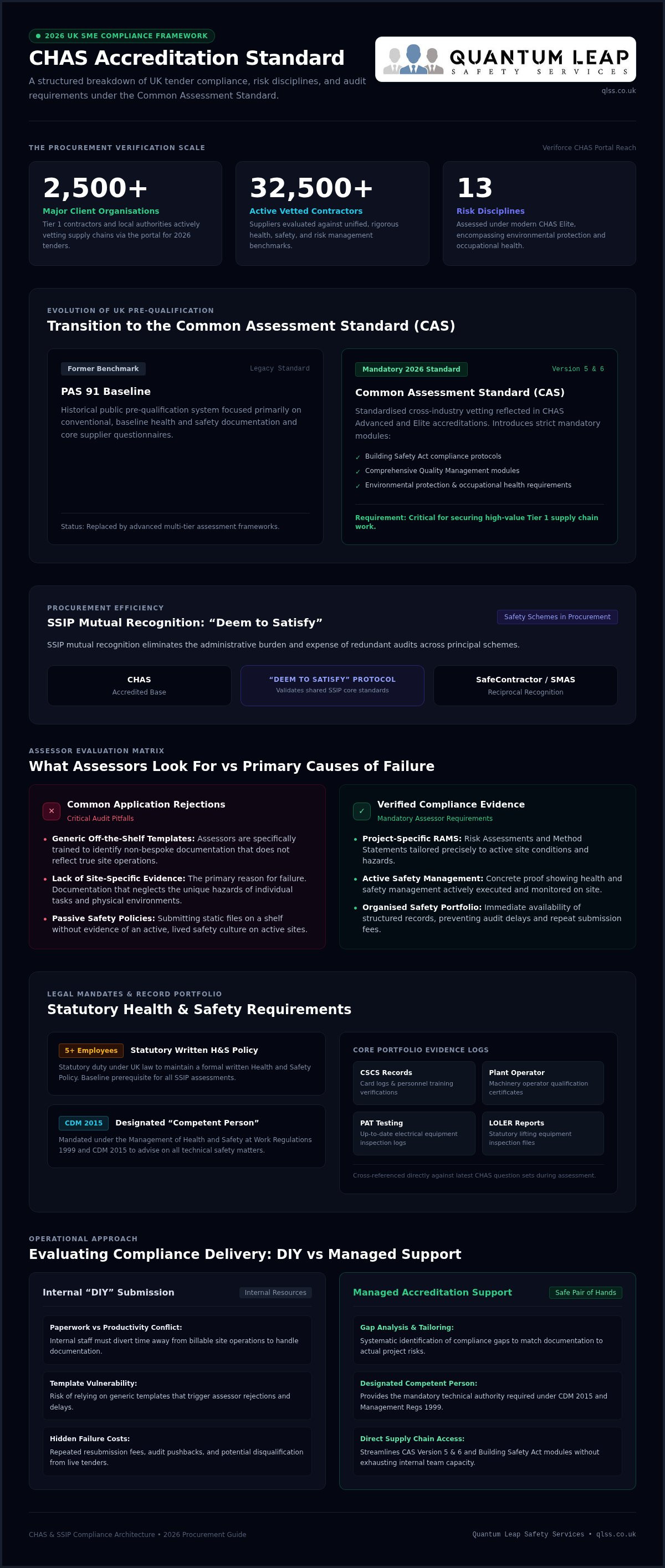
CHAS, or the Contractors Health and Safety Assessment Scheme, is a cornerstone of the UK construction and maintenance sectors. Since its inception, it's evolved from a simple safety checklist into a comprehensive risk management framework. In 2026, holding a valid CHAS certificate is often the minimum entry requirement for tendering. Principal contractors and local authorities use the Veriforce CHAS portal to vet over 32,500 active contractors. They want to ensure every supplier meets the same rigorous standards. This protects the supply chain and reduces corporate risk.
For many businesses, the shift towards CHAS Advanced and CHAS Elite levels reflects a broader industry move toward the Common Assessment Standard (CAS). Version 5 and 6 of the CAS mandate strict building safety and quality management modules. This creates a significant challenge for SMEs who must balance hands-on site work with complex compliance audits. Accessing professional CHAS accreditation support for SMEs is no longer just a convenience. It's a strategic necessity to remain competitive in a market where "basic" safety is no longer enough to secure high-value contracts.
The Role of SSIP in Modern Tendering
Safety Schemes in Procurement (SSIP) was established to reduce the administrative burden on contractors. It allows for mutual recognition between different schemes like CHAS, SafeContractor, and SMAS. If your business holds one accredited certificate, you can often obtain others through a "Deem to Satisfy" protocol. This system ensures that you don't have to pay for redundant audits. Modern CHAS Elite assessments have expanded to cover 13 distinct risk disciplines. These include environmental protection and occupational health services for SMEs, ensuring that your workforce remains protected beyond immediate site hazards.
Overcoming the SME Compliance Burden
The dilemma for small business owners is often "paperwork vs. productivity". It's easy to fall into the trap of using generic, off-the-shelf templates. However, assessors are now trained to spot "template" submissions that don't reflect the reality of your specific projects. A lack of site-specific evidence is a primary reason for application rejections. You need documents that actually match your work.
To pass the audit, you must demonstrate a clear understanding of the Construction (Design and Management) Regulations 2015. These regulations require every project to have a designated "competent person" to advise on safety matters under the Management of Health and Safety at Work Regulations 1999. Many SMEs find that partnering with a consultancy provides the necessary technical authority to satisfy these legal duties whilst keeping their internal team focused on project delivery. This approach provides a "safe pair of hands" for your business.
Understanding the CHAS Standard: What Assessors Look For
Assessors look for proof of active safety management. They aren't interested in a dusty folder on a shelf; they want to see that your safety culture is alive on site. It isn't enough to have a policy; you must show it in action. Generic, off-the-shelf documents are the most common reason for application failure. Your Risk Assessments and Method Statements (RAMS) must reflect the actual hazards of the specific project you're working on. This level of detail demonstrates that you've considered the unique risks of the environment and the tasks at hand.
Evidence for staff training and equipment maintenance is equally vital. You'll need to provide clear records of CSCS cards, training certificates, and plant operator qualifications. For equipment, assessors expect to see up-to-date PAT testing logs and LOLER inspection reports where applicable. Keeping these records organised is a central pillar of successful CHAS accreditation support for SMEs, as it allows you to respond to assessor queries without delay.
Core Health and Safety Requirements
Companies with five or more employees have a statutory duty to maintain a written Health and Safety Policy. This is a baseline requirement for any SSIP assessment. You should refer to the HSE guidance on health and safety basics for business to ensure your core documentation meets legal standards. Assessors also require proof of workplace health surveillance programs if your staff are exposed to noise, vibration, or hazardous substances. Accurate RIDDOR reporting logs and accident books are also essential pieces of evidence that prove you're monitoring workplace safety effectively.
Environmental and Quality Modules
The industry is moving toward broader ESG (Environmental, Social, and Governance) requirements. CHAS Advanced and Elite tiers now scrutinise your environmental impact and quality management systems. Holding an ISO 9001 certificate can significantly streamline this process. In fact, ISO 9001 implementation services UK help pre-qualify businesses for these higher CHAS levels by establishing a disciplined quality framework. You'll need to provide evidence of waste management protocols, carbon reduction plans, and modern slavery policies. Navigating these layers of evidence can be time-consuming, so seeking professional compliance assistance helps you present your data in a way that assessors find easy to verify.
Evaluating CHAS Accreditation Support: DIY vs. Professional Consultancy
Choosing between internal management and external consultancy is a critical decision for any SME. Whilst the DIY approach seems cost-effective on the surface, it often masks significant operational risks. Professional CHAS accreditation support for SMEs provides a methodical path through the audit, ensuring that your submission is right the first time. This isn't about simply ticking boxes; it's about having a dedicated expert who understands the nuances of the 2026 assessment standards and can translate them into practical site records.
There is a common misconception that consultancy is only for large corporations with massive budgets. In reality, the Safety Schemes in Procurement (SSIP) framework is specifically designed to be accessible, but the evidence requirements are high for everyone. Professional support levels the playing field for smaller firms. It ensures your safety documentation reflects your actual site practices whilst providing the year-round stability needed to maintain your status through the annual renewal cycle. Having a "safe pair of hands" to guide you prevents the stress of last-minute scrambles when a major tender opportunity arises.
The True Cost of Internal Management
Internal management requires a significant investment of time that most business owners simply don't have. Gathering evidence, reviewing policies, and managing mandatory safety training coordination can take dozens of man-hours. When an internal manager attempts this alongside their primary role, details are often missed. A single rejection from an assessor doesn't just mean a lost application fee; it can lead to weeks of delays. For a trade contractor, this delay might mean missing the start date for a lucrative Tier 1 project, resulting in thousands of pounds in lost revenue and a damaged reputation with the client.
Benefits of Managed Accreditation Services
Managed services provide reassurance by conducting a thorough gap analysis before any documents are submitted. This proactive approach identifies missing training records or outdated risk assessments that would otherwise trigger a failure. A core benefit of this partnership is the provision of a "Competent Person", which is a statutory requirement under UK safety law. Rather than hiring a full-time safety officer, outsourced QSHE managed services give you access to high-level expertise at a fraction of the cost. This model ensures your compliance is managed by professionals who deal with assessors every day, allowing your team to focus entirely on project delivery and business growth.
Preparing Your Application: Evidence and Documentation Checklist
Gathering a "Safety Portfolio" is the most time-consuming part of the accreditation process. The Veriforce CHAS portal is a container for your data, but it doesn't create the content for you. You must cross-reference your site records with the CHAS question set to ensure every claim you make is backed by verifiable proof. Professional CHAS accreditation support for SMEs often focuses on this stage because it's where most applications fail. Rejections usually stem from simple oversights, such as expired insurance certificates or training records that lack operative signatures.
Your insurance documentation must be current and meet the minimum indemnity levels required by your clients. Typically, this includes Employers' Liability and Public Liability insurance. You should also verify that your training matrix is audit-ready. Assessors expect to see a logical link between the tasks you perform and the qualifications of your staff. If you're unsure if your documentation is audit-ready, you can request a professional documentation audit to identify gaps before you submit.
Gathering Safety Policies and Risk Assessments
Your policies must reflect the legislative landscape of 2026, particularly regarding the Building Safety Act duties. It isn't enough to have a generic Risk Assessment and Method Statement (RAMS) in a folder. You must demonstrate that these documents are communicated to your staff. Photographic evidence from active sites is an excellent way to prove your policies are being followed. Photos showing correct PPE usage, clear safety signage, and well-maintained equipment provide "proof of life" for your safety system. Assessors value these real-world examples far more than signed templates.
Demonstrating Competent Safety Advice
A common reason for application deferral is the failure to prove access to competent safety advice. The assessor needs to see the CV and professional qualifications, such as NEBOSH or NVQ Level 5/6, of your designated safety advisor. You must also document that this advice is ongoing rather than a one-off purchase of a manual. This could include records of safety briefings, site inspections, or email correspondence regarding specific hazards. Under Regulation 7 of the Management of Health and Safety at Work Regulations 1999, a competent person is defined as someone who has sufficient training and experience or knowledge and other qualities that allow them to assist you in meeting your health and safety obligations.
Securing Your Status with Quantum Leap Safety Services
Quantum Leap Safety Services provides a dedicated, hands-on partnership to help you navigate the complexities of 2026 compliance. We recognise that every business has different resource constraints, which is why we offer both "Done-For-You" and "Guided" support packages. Our CHAS accreditation support for SMEs is designed to take the weight off your shoulders whilst ensuring your documentation is beyond reproach. We act as a "safe pair of hands", bringing technical authority and a pragmatic, common-sense approach to your safety management.
Our expertise isn't limited to a single sector. Since 2012, we've supported contractors across the construction, renewables, and fire safety industries. This broad experience allows us to anticipate the specific evidence requirements that assessors look for in different trades. We don't just help you get the badge; we help you build a more resilient business. Our focus remains on operational efficiency and the fulfilment of your legal obligations without creating unnecessary bureaucracy.
Our Methodical Approach to CHAS Applications
We begin every project with a thorough initial audit and gap analysis. This process identifies exactly where your current documentation falls short of the 2026 CHAS Elite or Advanced standards. Once the gaps are identified, we build a custom safety management system tailored to your SME. This isn't a generic template; it's a functional framework that reflects how you actually work on site. We also manage the direct liaison with CHAS assessors. If they have a query about your submission, we handle the communication to resolve the issue quickly and prevent application rejections.
Beyond the Badge: Long-Term Compliance
A CHAS certificate is a significant milestone, but it's only one part of a total compliance solution. We help you integrate your accreditation into a wider fire safety management plan and quality protocols. Many of our clients choose our retainer service to ensure they remain audit-ready throughout the year. This service includes annual renewals, regular site audits, and ongoing competent person support. It provides the stability needed to maintain your status in high-value supply chains without the stress of a last-minute scramble every twelve months.
Securing your accreditation should be a disciplined, process-driven exercise that adds value to your business. If you're ready to streamline your safety documentation and access more lucrative contracts, we can help. Enquire about our CHAS support packages today to discover how we can manage your compliance journey with professional precision.
Future-Proofing Your Business with CHAS Compliance
Securing your CHAS accreditation in 2026 is a strategic step toward accessing high-value supply chains and protecting your workforce. Success depends on moving beyond generic templates and providing assessors with site-specific evidence that reflects your actual safety culture. By appointing a competent person and maintaining a disciplined "Safety Portfolio", you fulfil your legal obligations whilst demonstrating technical authority to principal contractors. Professional CHAS accreditation support for SMEs ensures these requirements are met with precision, allowing you to focus on operational growth rather than administrative delays.
Quantum Leap Safety Services has acted as a "safe pair of hands" for UK businesses since 2012. As a pragmatic QSHE consultancy, we provide the expertise needed to navigate complex audits through managed service retainers and tailored support packages. Our methodical approach ensures your compliance is steady and reliable, both for initial assessments and annual renewals. If you're ready to streamline your documentation and secure your status in the market, Get Expert CHAS Accreditation Support for Your SME today. We look forward to helping your business thrive in a safer, more compliant future.
Frequently Asked Questions
What is CHAS accreditation and why is it important for UK SMEs?
CHAS (Contractors Health and Safety Assessment Scheme) is a pre-qualification scheme that verifies your business meets core health and safety standards. It's essential for SMEs because principal contractors and local authorities mandate it for tenders. Holding this accreditation proves you're a safe supplier, opening doors to high-value contracts. It also simplifies the procurement process by aligning with the SSIP framework, which reduces the need for multiple, redundant safety audits across different platforms.
How long does the CHAS application process usually take with professional support?
The timeline typically ranges from two to six weeks, depending on the current state of your documentation. Professional support accelerates this by conducting an immediate gap analysis and drafting missing policies quickly. Once submitted, the CHAS assessment team usually reviews applications within ten working days. Expert guidance prevents the common back-and-forth queries that often delay unassisted applications, ensuring a smoother and more predictable route to certification for your business.
Can a small business with fewer than five employees get CHAS accredited?
Yes, micro-businesses and sole traders can achieve CHAS accreditation. Whilst companies with fewer than five employees aren't legally required to have written safety policies under the Health and Safety at Work etc. Act 1974, CHAS still requires evidence of safe working practices. You'll need to demonstrate your competence through training records, insurance certificates, and site-specific risk assessments. This proves to larger clients that you manage risks professionally regardless of your business size.
What is the difference between CHAS Standard, Advanced, and Elite memberships?
CHAS Standard focuses on core health and safety (SSIP). CHAS Advanced adds modules for environmental management, quality, and financial standing. CHAS Elite is the most comprehensive tier, aligning with the Common Assessment Standard (CAS). It covers thirteen risk areas, including modern slavery and information security. Choosing the right level depends on your target contracts; many Tier 1 contractors now mandate the Elite level for all their primary supply chain partners to ensure total compliance.
Do I need a "Competent Person" to pass my CHAS assessment?
Yes, appointing a "Competent Person" is a mandatory requirement under the Management of Health and Safety at Work Regulations 1999. CHAS assessors will look for evidence that you have access to professional safety advice, whether internal or through an external consultancy. You must provide the qualifications and experience of this advisor. This ensures your business has the technical knowledge to manage site-specific hazards and maintain a robust safety management system throughout the year.
How much does CHAS accreditation support for SMEs typically cost?
The cost of CHAS accreditation support for SMEs varies based on the level of membership required and the complexity of your existing safety systems. Fees generally cover the initial audit, documentation drafting, and liaison with the assessor. Rather than a one-off cost, many businesses opt for a managed service retainer. This provides ongoing compliance stability and covers annual renewals, making it a more cost-effective solution than hiring a full-time safety officer to manage the process.
What happens if my business fails the CHAS audit?
If your application is deferred, the assessor will provide a list of "non-conformances" that need addressing. You aren't permanently barred; you're given a specific timeframe to upload the missing evidence or correct the documentation. Using professional CHAS accreditation support for SMEs significantly reduces this risk by identifying gaps before submission. If a deferral does occur, a consultant can help you interpret the assessor's feedback and implement the necessary changes to secure a pass.
How often do I need to renew my CHAS accreditation status?
CHAS accreditation requires an annual renewal to ensure your safety standards remain current. Your certificate is valid for exactly twelve months from the date of issue. The renewal process involves a fresh audit of your updated insurance, training records, and recent site-specific risk assessments. Maintaining a disciplined record-keeping system throughout the year makes this annual task much simpler. Managed service retainers often include this renewal management as a standard feature to prevent status lapses and lost contracts.


Comments