
Wind Farm Health & Safety: UK Compliance Guide (2026)
In 2025, the UK onshore wind sector recorded 669 health and safety incidents; a figure that highlights the significant challenges facing operators as wind power now generates over a quarter of our national electricity. Managing health and safety for wind farms is an increasingly complex responsibility, especially with the introduction of the new Wind Turbine System Safety Rules in March 2026. You likely recognise that balancing rigorous compliance with the practical demands of remote site management is a difficult, high stakes task.
This guide provides a pragmatic framework to help you master these regulatory complexities and implement a robust QSHE system. We'll outline your clear legal duties, offer a practical approach to risk mitigation, and show you how to ensure operational continuity without safety related delays. By the end of this article, you'll have a methodical roadmap to navigate CDM, LOLER, and subcontractor management with total confidence. We aim to provide the steady, professional guidance required to protect your workforce and maintain your project's stability in an evolving energy market.
Table of Contents
Understanding the Unique Hazards of Wind Farm Environments
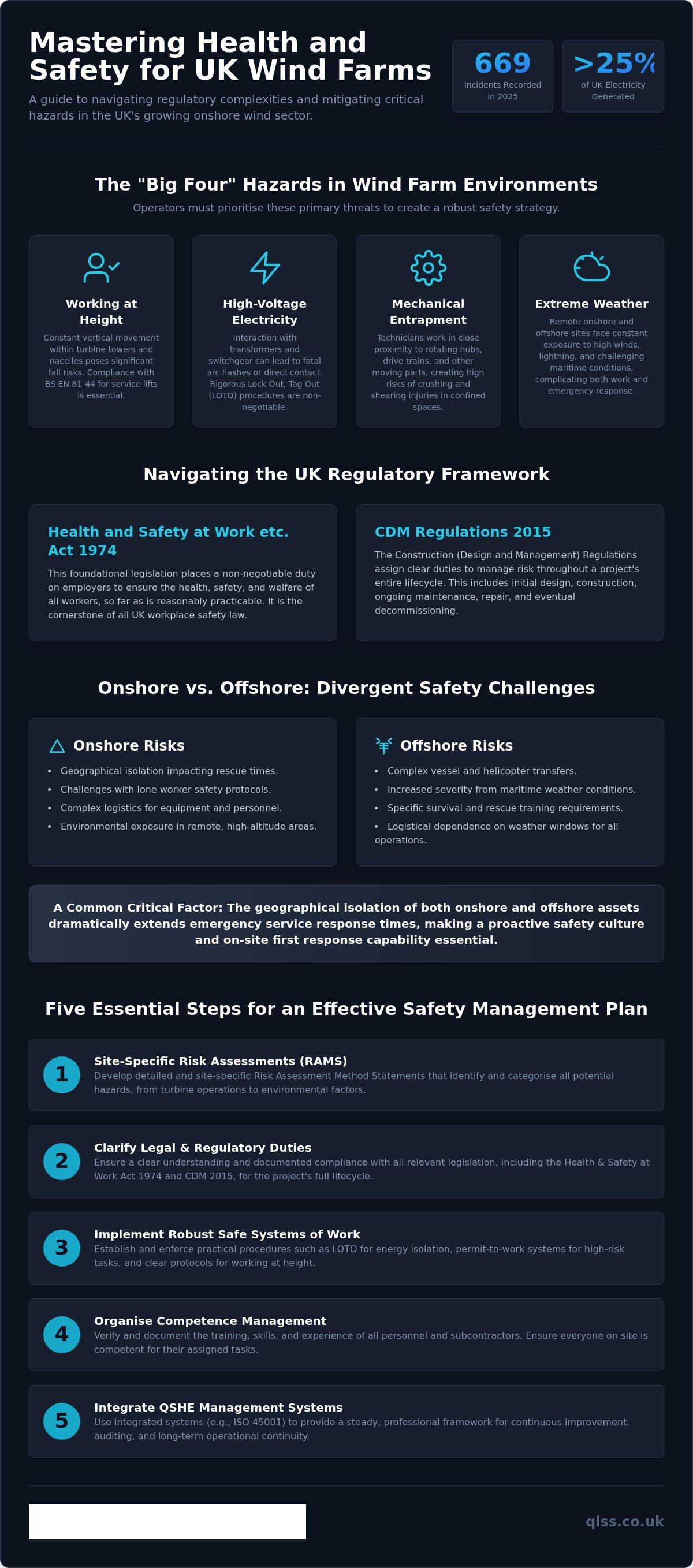
Managing health and safety for wind farms is a specialised subset of industrial QSHE management, requiring technical competencies that go beyond standard construction safety. It's a field defined by high-altitude infrastructure, high-voltage systems, and challenging environmental conditions. Operators must account for the dynamic nature of wind turbines, where the interaction between mechanical, electrical, and structural components creates a unique risk profile. Primary threats are categorised into the "Big Four" hazards:
Working at height: Constant vertical movement within towers and nacelles.
High-voltage electricity: Complex power generation and transmission systems.
Mechanical entrapment: Proximity to rotating hubs and drive trains.
Extreme weather: Exposure to high winds, lightning, and maritime conditions.
The geographical isolation of these assets adds a layer of severity to any standard accident. In traditional industrial settings, emergency services are usually minutes away. However, on remote onshore sites or offshore platforms, rescue times are often extended by weather windows and complex logistics. This reality makes a safety-first culture amongst subcontractors essential. It isn't just about following rules; it's about ensuring every individual on site can act as a competent first responder if required. Understanding the Environmental impact of wind power also requires a pragmatic look at the human health risks associated with maintaining infrastructure in these demanding locations.
The Danger of Working at Height and Service Lifts
Vertical transit within a turbine is a daily requirement. Compliance with BS EN 81-44 is essential for turbine service lifts, as this standard dictates the specific safety requirements for lifting persons in these unique vertical environments. In the confined space of a nacelle, the risks of crushing and shearing are high. Technicians must be acutely aware of moving parts and structural pinch points. The danger zone in lift operations is defined by the safety distances required to prevent hazard zones being reached by upper and lower limbs as specified in ISO 13857.
Electrical and Mechanical Risks in Power Generation
Commissioning and maintenance phases present the highest risk for high-voltage (HV) incidents. Technicians interact with transformers and switchgear where an arc flash or direct contact can be fatal. Mechanical guarding is equally vital, particularly within the turbine hub where moving parts remain accessible during certain maintenance tasks. Implementing rigorous Lock Out, Tag Out (LOTO) procedures is non-negotiable for maintaining health and safety for wind farms, ensuring that energy sources are isolated and verified before any work commences. These protocols provide a pragmatic safeguard against accidental re-energisation in complex, multi-system environments.
Navigating the UK Regulatory Framework for Renewables
The UK regulatory landscape is governed primarily by the Health and Safety at Work etc. Act 1974. This legislation places a non-negotiable duty on employers to ensure the welfare of workers so far as is reasonably practicable. In the renewables sector, this high-level duty is refined by specific statutory instruments that manage the high-risk nature of the work. Achieving consistent Health and safety compliance in wind farms requires a methodical understanding of how these laws overlap during different project phases, from initial groundworks to long-term operation.
CDM 2015: From Development to Decommissioning
The Construction (Design and Management) Regulations 2015 (CDM) are central to wind farm development. These rules assign clear responsibilities to the Principal Designer and Principal Contractor to manage risks from the outset. For any onshore or offshore project, a comprehensive Construction Phase Plan (CPP) must be in place before work begins. These duties don't vanish once the turbines start turning; maintenance, repair, and eventual decommissioning are still classed as "construction work" under the regulations. Maintaining a continuous QSHE framework ensures that health and safety for wind farms remains a priority throughout the asset's entire lifecycle.
Statutory Inspections and LOLER Compliance
The Lifting Operations and Lifting Equipment Regulations (LOLER) are critical for turbine maintenance. Every service lift, crane, and chain hoist within the nacelle must undergo statutory inspections to remain operational. Accessories used for lifting people require a thorough examination every 6 months, whilst other lifting equipment generally follows a 12-month cycle. These inspections must be performed by a "competent person" who possesses the required practical and theoretical knowledge to detect defects. A robust, digital audit trail is the only way to demonstrate compliance during an HSE inspection and prevent costly project delays.
Beyond UK statutory law, the Global Wind Organisation (GWO) sets the international standard for safety training. GWO certification ensures that technicians possess the specific skills needed for sea survival, manual handling, and fire awareness in a turbine environment. Managing these training matrices and statutory inspection schedules can be overwhelming for growing operators. Engaging Renewable Projects Support provides the professional oversight needed to bridge the gap between regulatory theory and site-level practice. This steady, grounded approach ensures your project remains compliant whilst protecting the long-term stability of your workforce.
Onshore vs. Offshore: Divergent Safety Standards and Requirements
Geographic location is the primary factor in determining the complexity of your safety management plan. Whilst the mechanical risks of a turbine nacelle remain consistent, the environment surrounding the asset dictates your approach to emergency response and personnel oversight. Managing health and safety for wind farms on land requires a focus on public interaction and vast logistical footprints, whereas offshore operations are defined by marine coordination and survival training. Each setting demands a distinct Safe System of Work (SSoW) to account for these environmental variables.
Onshore Challenges: Public Access and Land Management
Onshore projects often involve "lone worker" scenarios. Technicians frequently operate across expansive agricultural or moorland holdings where mobile signal can be unreliable. This presents significant communication challenges; a steady, reliable system for checking in is essential to ensure help is available if an accident occurs. There's also a clear duty to protect the public. Risks such as ice throw or noise emissions must be strictly managed to safeguard local residents and visitors. Fire safety management for remote sub-stations is another critical onshore priority, as these sites are often difficult for local fire services to reach quickly.
Offshore Extremes: Survival and Marine Coordination
Offshore environments present extreme logistical hurdles. Every technician must hold a GWO Sea Survival certificate, as the risk of falling into the water during a vessel transfer is a constant reality. Safety management here moves beyond the turbine itself; it involves the complex coordination of Crew Transfer Vessels (CTVs) and Service Operation Vessels (SOVs). Environmental compliance also shifts from land-based noise regulations to marine licensing and the protection of subsea ecosystems. Detailed guidance on UK wind farm health and safety compliance highlights how these maritime stressors require specific attention to hazardous substances and confined space entries.
Technical integrity is harder to maintain at sea. Salt-water corrosion significantly impacts the reliability of safety equipment and service lifts. This means inspection intervals often need to be more frequent than the statutory minimums to account for the harsh maritime climate. Maintaining health and safety for wind farms in these conditions requires a proactive, methodical approach to asset management. It's about being a "safe pair of hands" in an environment that allows very little room for error.
Five Essential Steps to Organise an Effective Safety Management Plan
Organising health and safety for wind farms requires a shift from theoretical compliance to site-level application. A high-performing safety management plan isn't a static document; it's a methodical framework that adapts to the specific risks of your infrastructure. To achieve this, we recommend five essential steps:
Conduct site-specific RAMS: Move beyond generic templates to address the exact terrain, turbine model, and specific task at hand.
Establish a Competence Management System (CMS): Ensure every contractor has verified, up-to-date certifications for their specific role before they set foot on site.
Implement a Permit to Work (PTW) system: Control high-risk activities, such as high-voltage switching or confined space entry, through a formal authorisation process.
Organise regular QSHE Audits: Identify "compliance drift" where site practices begin to deviate from established safety protocols over time.
Create a comprehensive ERRP: Map out exactly how a rescue will be executed from the top of a tower or a remote sub-station.
Developing Actionable RAMS for Turbine Work
Generic risk assessments are often insufficient because they fail to account for the micro-climates and specific structural quirks of a particular site. Your Method Statements must be actionable and grounded in reality. They should incorporate Dynamic Risk Assessments (DRA) to manage changing wind speeds or shifting visibility during a shift. For safety to be effective, RAMS must be communicated in plain English to everyone on site, ensuring that every technician understands their role in the wider safety ecosystem.
Emergency Response: Beyond the Standard First Aid
In a turbine environment, standard first aid is rarely enough. The "golden hour" for medical intervention is extremely tight when a technician is 100 metres in the air or miles offshore. You must have specialised rescue equipment on-site, including constant rate descenders and stretchers designed for narrow turbine ladders. Regular rescue drills are the only way to maintain team competence and ensure that your emergency response is instinctive rather than reactive. This level of preparation is a non-negotiable part of health and safety for wind farms.
Building this level of operational resilience takes technical expertise and consistent oversight. If you're looking to streamline your compliance, our QSHE Managed Services provide a "safe pair of hands" to manage your safety management plan from inception to audit. This proactive approach ensures your project stays on track whilst protecting your most valuable assets.
How Managed QSHE Services Future-Proof Wind Energy Projects
For many SMEs in the renewable sector, maintaining a full-time, in-house safety department is often disproportionate to their immediate resource constraints. However, the legal obligations remain just as stringent. This is where the "safe pair of hands" model becomes invaluable. By utilising managed QSHE services, businesses gain access to senior-level expertise and technical authority without the overhead of a permanent executive salary. It's a pragmatic way to ensure that health and safety for wind farms is managed by professionals who understand the specific nuances of high-risk energy infrastructure.
Operational efficiency is significantly improved through integrated ISO management systems. When ISO 9001 (Quality), ISO 14001 (Environmental), and ISO 45001 (Occupational Health and Safety) are managed as a single, unified framework, it eliminates the friction of departmental silos. This holistic approach ensures that safety protocols don't just exist to prevent accidents but also to support environmental compliance and quality control. Professional training management further protects the business by ensuring that no GWO or technical accreditations lapse, preventing costly "stop-work" orders during critical maintenance windows.
The Advantage of a QSHE Managed Service Retainer
A managed service retainer provides continuous access to "Competent Advice," a mandatory requirement under the Management of Health and Safety at Work Regulations 1999. It's a proactive investment that's far more cost-effective than the reactive expenses associated with HSE "Fee for Intervention" (FFI) costs or potential fines. Regular audits ensure that "Total Compliance" is maintained across all remote sites, identifying risks before they manifest as incidents. You can learn more about how this steady oversight protects your operations by exploring our QSHE Managed Services.
Achieving Industry Accreditations (CHAS, SafeContractor)
Robust safety management is the foundation for winning major tenders in the UK wind market. Principal contractors and developers require proof of high standards, typically through SSIP schemes like CHAS or Alcumus SafeContractor. A methodical QSHE framework simplifies the application process for these accreditations, as all the required evidence and audit trails are already in place. These badges of competence aren't just administrative hurdles; they're vital tools for business growth that signal your reliability to the wider industry. If you're ready to secure your project's future, contact Quantum Leap Safety Services for a bespoke renewable project safety audit. Our grounded, professional approach provides the stability you need to navigate the complexities of corporate responsibility with confidence.
Securing Operational Stability in the Renewable Sector
Maintaining high standards in health and safety for wind farms is a continuous process of risk mitigation and regulatory alignment. By moving beyond generic safety templates and adopting a site-specific, methodical approach, you protect both your workforce and your project's long-term commercial viability. We've explored how navigating CDM 2015 and LOLER requirements requires technical authority, especially when managing the divergent risks of onshore and offshore environments.
As a UK-wide professional safety consultancy, we specialise in ISO 45001 and CDM compliance to provide a "safe pair of hands" for your operations. Our expert support for renewable and construction projects ensures that your safety management plan remains a living, effective framework rather than a static document. Implementing these standards doesn't just fulfil a legal obligation; it builds a culture of reliability that supports business growth and operational continuity.
Ensure your renewable project is fully compliant with our QSHE Managed Services. With the right professional partnership, you can navigate the complexities of modern energy infrastructure with total confidence and stability.
Frequently Asked Questions
What is the primary legislation for wind farm safety in the UK?
The Health and Safety at Work etc. Act 1974 is the foundational legislation, requiring employers to ensure worker welfare so far as is reasonably practicable. This is supplemented by the Management of Health and Safety at Work Regulations 1999. In the renewables sector, the Construction (Design and Management) Regulations 2015 (CDM) are also vital, governing the safety of the project from the initial design phase through to decommissioning.
Do I need a specialised safety officer for a small onshore wind project?
Legally, you must have access to competent advice to manage health and safety for wind farms, regardless of the project's scale. For small onshore developments, hiring a full-time safety officer is often impractical. Instead, many SMEs utilise managed QSHE services or safety retainers. This provides the necessary technical authority and site-level oversight without the overhead of a permanent staff member, ensuring your project remains compliant with UK statutory requirements.
How often should wind turbine service lifts be inspected?
Under the Lifting Operations and Lifting Equipment Regulations (LOLER), wind turbine service lifts must undergo a thorough examination every six months because they are used to lift people. Any other lifting accessories or machinery not used for personnel typically require an inspection every 12 months. These audits must be conducted by a competent person with the required technical knowledge to identify potential defects that could compromise the safety of the turbine technicians.
What is GWO training and is it mandatory for wind farm workers?
GWO training refers to the safety standards established by the Global Wind Organisation. Whilst not a statutory legal requirement in the same way as HASWA 1974, most UK wind farm operators and principal contractors make GWO certification a mandatory condition for site access. These modules cover essential skills like sea survival, fire awareness, and manual handling, ensuring that all personnel possess a verified baseline of safety competence for high-risk environments.
How does CDM 2015 affect wind farm owners and operators?
CDM 2015 places specific legal duties on wind farm owners as Clients. You are responsible for ensuring that the Principal Designer and Principal Contractor are competent and that a comprehensive Construction Phase Plan is in place. These duties don't end once construction is finished; any significant maintenance or repair work during the operational phase is still classified as construction, meaning your CDM obligations persist throughout the entire lifecycle of the asset.
What are the most common causes of accidents on wind farms?
The most frequent causes of incidents involve falls from height, electrical arc flashes during high-voltage work, and mechanical entrapment within the turbine hub. Environmental factors also play a significant role; extreme weather can lead to slips or lightning strikes. In 2025, the UK onshore sector saw 669 recorded health and safety incidents. Many of these occur during the commissioning and maintenance phases where technicians are in close proximity to moving parts.
Can I outsource my entire health and safety management for a renewable project?
You can outsource the delivery and coordination of your safety framework to a specialist consultancy. Managed QSHE services can handle risk assessments, training matrices, and statutory audits on your behalf to maintain health and safety for wind farms. However, under UK law, the Client or owner retains ultimate legal responsibility for the safety of the project. Outsourcing provides you with a safe pair of hands to manage the daily complexities whilst fulfilling your professional obligations.

Comments