
ISO 45001 Certification Consultancy: The SME Guide to Occupational Health & Safety
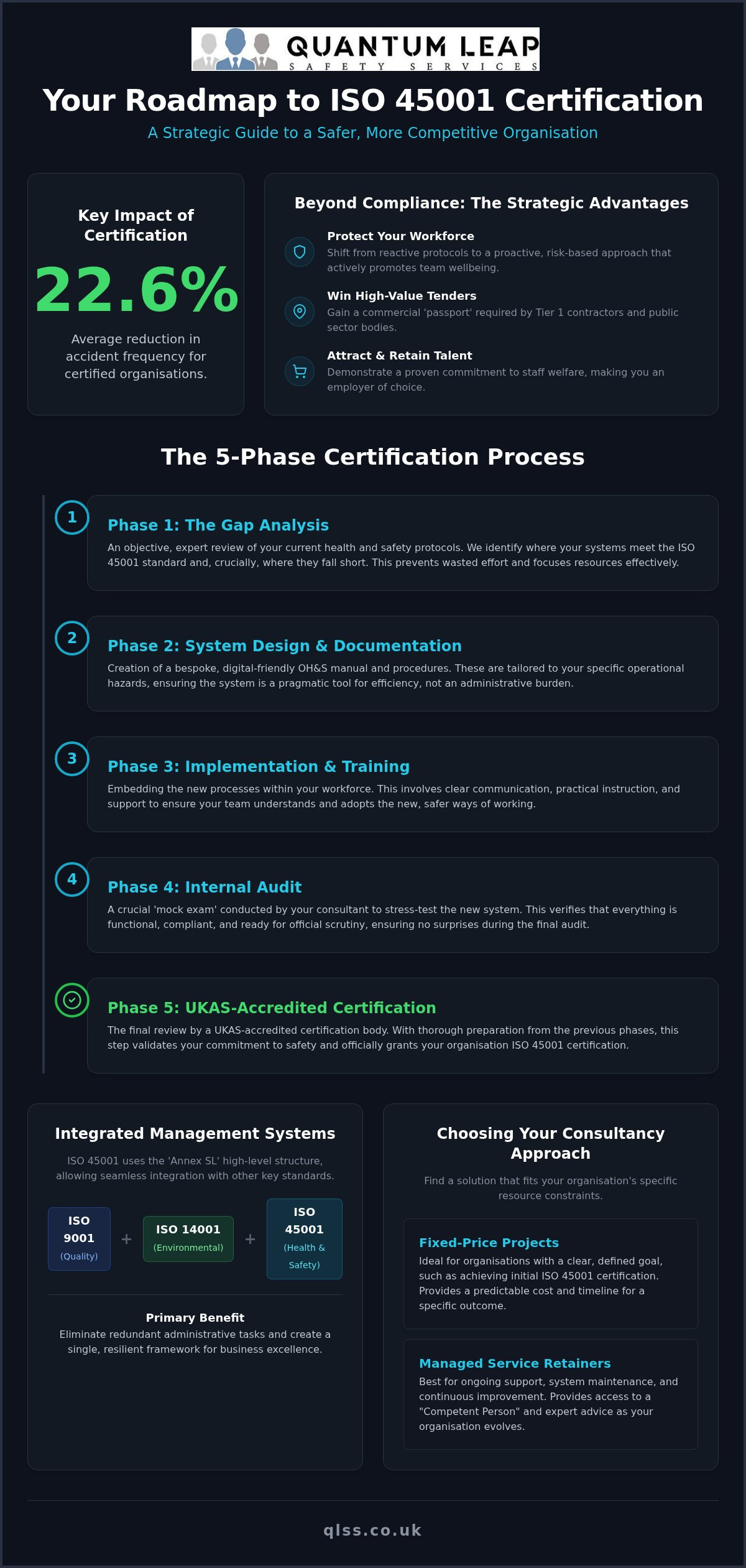
Did you know that organisations with ISO 45001 certification see a 22.6% average reduction in accident frequency? For many small business owners, the path to achieving this standard often feels like a mountain of complex jargon and administrative burden. You likely recognise that a robust safety system is vital for protecting your team and winning high-value tenders, but the fear of failing a UKAS audit can keep the process on the back burner. It's a common challenge to balance daily operations with the rigorous demands of international compliance whilst managing limited internal resources.
Partnering with a professional ISO 45001 certification consultancy simplifies this journey, turning a daunting regulatory requirement into a pragmatic operational asset. This guide explains how expert support streamlines your transition to the 2018 standard while reducing operational risk and lifting employee morale. We'll explore the steps to building a digital-friendly safety system that satisfies auditors and gives your business a genuine competitive edge. Discover how to move beyond basic compliance to create a safer, more efficient workplace that stands up to the closest scrutiny.
Table of Contents
What is ISO 45001 and Why Does Your Organisation Need a Consultant?
ISO 45001 is the definitive international standard for Occupational Health and Safety (OH&S). It provides a structured framework for organisations to manage risks and improve their safety performance. Since the transition from the older OHSAS 18001 standard, which expired in 2021, the focus has shifted significantly. The modern standard is far more proactive. It requires leadership teams to integrate safety into the heart of their business strategy rather than treating it as a peripheral administrative task.
The core objective of the standard is to reduce workplace injuries and ill-health whilst actively promoting the physical and mental wellbeing of your team. For small and medium-sized enterprises (SMEs), this transition offers substantial strategic value. Beyond the obvious moral obligation to protect staff, a certified management system often leads to reduced insurance premiums. Underwriters recognise that certified firms represent a lower risk, which directly benefits your bottom line.
The Role of an ISO 45001 Certification Consultant
UK health and safety legislation requires every employer to appoint a "Competent Person" to help them meet their legal duties. Engaging a professional ISO 45001 certification consultancy provides access to this high-level expertise without the cost of a full-time executive hire. Consultants act as a bridge between complex regulatory requirements and your daily operations. They translate technical standards into pragmatic, actionable processes that your team can actually follow.
A consultant provides an essential, objective perspective during the initial gap analysis phase. It's often difficult for internal teams to spot systemic weaknesses in their own environment. An external expert identifies exactly where your current behaviour meets the standard and where it falls short. This ensures you don't waste time or money on unnecessary changes. By tailoring the system to your specific operational hazards, a consultant ensures the management system is a tool for efficiency rather than a burden.
Beyond Compliance: The Competitive Advantage
In high-risk sectors such as construction and renewable energy, ISO 45001 certification acts as a vital commercial "passport". Most Tier 1 contractors and public sector bodies now require this accreditation as a prerequisite for high-value tenders. Without it, your business may be excluded from lucrative contracts before you've even submitted a bid. Professional support from an ISO 45001 certification consultancy ensures your system meets the rigorous requirements of UKAS-accredited auditors, giving you the best chance of success in these competitive markets.
A robust safety culture also serves as a powerful recruitment and retention tool. In a tight labour market, skilled workers gravitate towards employers who can prove they value staff welfare. This standard uses Annex SL, which is the common high-level framework used by all modern ISO standards to ensure different management systems can be integrated seamlessly. This alignment reduces duplication of effort and makes your business more resilient and attractive to both clients and talent alike.
The Roadmap to Certification: A Step-by-Step Consultancy Process
Achieving international accreditation isn't a matter of chance; it's the result of a methodical, logical sequence of actions. Engaging an ISO 45001 certification consultancy provides the structure needed to navigate this journey without disrupting your core business operations. The process aligns your existing safety behaviours with the official ISO 45001 standard, ensuring every requirement is met with precision and common sense.
The journey typically follows five distinct phases:
Phase 1: The Gap Analysis – A thorough review to identify where your current safety protocols meet the standard and where they fall short.
Phase 2: System Design & Documentation – Building a bespoke manual and procedures tailored to your specific operational hazards.
Phase 3: Implementation & Training – Embedding new processes amongst your workforce through clear communication and instruction.
Phase 4: Internal Audit – A "mock exam" conducted by your consultant to verify the system is functional and compliant.
Phase 5: Certification Audit – The final review by a UKAS-accredited body, where your consultant provides technical support and reassurance.
Conducting a Meaningful Gap Analysis
A gap analysis is more than a simple checklist. It involves a deep dive into your existing risk assessments and fire safety management plans to ensure they're robust enough for the modern standard. For businesses in the construction or renewable energy sectors, this stage is critical for identifying "legal and other requirements" that are unique to your high-risk environment. Your consultant will also evaluate the leadership team's current commitment to safety objectives. This isn't about finding fault; it's about establishing a steady baseline for improvement.
Documentation Without the Drama
Small teams often dread the administrative burden of ISO standards. A professional ISO 45001 certification consultancy ensures that your manual is streamlined and functional rather than a collection of dusty binders. We focus on creating clear incident reporting and investigation procedures that actually work for your team. This includes ensuring version control and accessibility for site-based or remote workers. For many SMEs, a structured approach through ISO management systems support provides the necessary stability to reach the finish line without the typical "paper-pushing" stress.
Once the documentation is in place, the focus shifts to implementation. This is where the standard comes to life. Your consultant helps you train staff on new procedures, ensuring that safety becomes a shared responsibility across the entire organisation. By the time the external UKAS auditor arrives, your team will feel confident and prepared, knowing that your system has already been tested through a rigorous internal audit process.
Choosing the Right Consultancy Approach: Retainers vs. Projects
Selecting the most effective engagement model for an ISO 45001 certification consultancy depends on your current internal capacity and long-term commercial goals. Small businesses often face a choice between a focused sprint to achieve accreditation or a steady marathon of continuous safety improvement. Both models offer distinct advantages for an SME budget, provided the consultant understands the specific risks associated with your industry. For a broader perspective on why this structured approach matters globally, you can review the International Accreditation Forum overview of ISO 45001.
The decision usually rests on whether you need a one-off implementation or ongoing professional oversight. In high-stakes sectors like renewable energy and construction, the cost of a safety failure far outweighs the investment in professional guidance. A project model gets you to the starting line; a retainer ensures you stay in the race.
When a Fixed-Price Project Makes Sense
Fixed-price projects are designed for organisations targeting a specific deadline. If you're preparing for a major contract bid or a high-value tender, this approach provides the necessary intensity to meet tight windows. It's particularly effective for businesses that already have a capable internal team but lack the technical knowledge to navigate the final stages of the standard. This model delivers a "quick win" by establishing a baseline of compliance and securing the initial certificate within a defined timeframe. It provides a clear, finite investment with a tangible outcome.
The Long-Term Value of Managed QSHE Services
For many SMEs, the real challenge begins after the certificate is on the wall. A managed service retainer provides an outsourced safety officer who ensures the management system doesn't sit on a shelf and gather dust. This approach offers continuous improvement through regular site safety inspections and internal audits, which are vital for maintaining high standards. It's a pragmatic way to stay ahead of changing UK health and safety legislation without the overhead of a full-time hire. By choosing a partner with deep experience in your specific sector, you ensure your safety culture remains both compliant and practical. This long-term partnership acts as a safe pair of hands, allowing your leadership team to focus on growth whilst remaining fully protected.
Integrating ISO 45001 with 9001 and 14001 Standards
Modern ISO standards share a common high-level framework known as Annex SL. This structure ensures that the core clauses across different management systems are identical, allowing for a "plug-and-play" approach to compliance. For an SME, this means you don't need to maintain three separate manuals. You can build a single, cohesive system that addresses quality, environmental impact, and safety simultaneously. This unified approach is where a professional ISO 45001 certification consultancy adds the most value, helping you map overlapping requirements to avoid redundant paperwork.
Integration allows you to hold a single management review meeting and conduct one integrated internal audit. This reduces the time commitment for your leadership team and minimises disruption for your staff. Research indicates that combining audits can reduce total audit costs by 35-45% compared to three separate assessments. It transforms your compliance from a series of disconnected silos into a robust Business Total Compliance Solution. By reducing the administrative burden, your team can focus on operational excellence rather than managing multiple sets of documentation.
Streamlining Quality and Safety
Building safety into your quality processes ensures that "doing it right" always means "doing it safely". This standard naturally complements ISO 9001 implementation services UK. By merging operational controls, you ensure that training records and staff competence assessments are managed in one place. It's a pragmatic way to ensure that safety isn't just a bolt-on but a core part of your service delivery. Engaging an ISO 45001 certification consultancy ensures that these overlaps are identified early, creating a streamlined system that satisfies both quality and safety auditors during a single visit.
The Environmental Connection
Many workplace hazards also carry significant environmental risks. Aligning your safety protocols with ISO 14001 implementation UK allows you to manage chemical hazards, spill responses, and waste protocols under a single framework. This doesn't just simplify administration; it strengthens your corporate social responsibility (CSR) profile. It demonstrates to prospective clients that you have a steady, methodical grip on every aspect of corporate responsibility. This total compliance approach is particularly persuasive in high-value tenders where environmental and safety records are scrutinised with equal intensity.
Achieving this level of synergy requires a partner who understands the intricacies of each standard. Our Business Total Compliance Solutions are designed to help you achieve multi-standard certification whilst keeping costs and administrative effort to a minimum.
Securing Your Certification with Quantum Leap Safety Services
Quantum Leap Safety Services (QLSS) acts as a dedicated partner for SMEs seeking to navigate the complexities of occupational health and safety. Since 2012, we've provided a "safe pair of hands" for businesses that need to meet intricate legal requirements without losing sight of their daily operations. Our approach is fundamentally grounded in common sense. We recognise that for a small team, a safety system must be a functional tool rather than an administrative burden. As a leading ISO 45001 certification consultancy, we bridge the gap between technical standards and practical, on-site reality.
Our consultants possess deep expertise in high-risk sectors, including renewable energy and construction QSHE services. These industries face unique hazards that require more than a generic safety manual. We provide national coverage across the UK, ensuring that whether your team is based on a remote wind farm or a busy urban construction site, you have access to expert support. This geographical reach allows us to maintain a consistent safety culture across your entire organisation, regardless of where your projects are located. Many of our clients choose to utilise our outsourced safety officer roles, which allows them to access professional QSHE management on a flexible basis that suits their specific needs.
Our Commitment to Your Success
We develop tailored implementation plans that respect your specific resource constraints. We don't believe in over-complicating processes for the sake of it. Our focus remains on operational efficiency and cost-consciousness, ensuring your investment in safety delivers a genuine return. With a proven track record of preparing clients for successful UKAS-accredited audits, we take the stress out of the certification process. We guide you through every stage, from the initial gap analysis to the final review, with a steady and methodical hand. Our goal is to ensure your system is robust enough to pass any inspection whilst remaining simple enough for your team to use every day.
Next Steps: Your Path to ISO 45001
Taking the first step towards international accreditation is straightforward. You can request a bespoke proposal that outlines a clear, logical roadmap for your certification journey. We also encourage you to book an initial consultation to discuss your specific safety goals and any operational challenges you currently face. You are invited to explore our "Total Compliance" packages, which provide a holistic solution for quality, environmental, and safety management in one integrated framework. Contact Quantum Leap Safety Services for a pragmatic approach to ISO 45001 and discover how we can help you protect your people and your business reputation.
Strengthening Your Business Through Strategic Safety Management
Achieving ISO 45001 certification transforms safety from a compliance burden into a genuine commercial advantage. A structured roadmap, from the initial gap analysis to the final audit, ensures your organisation meets international standards whilst protecting your most valuable asset: your people. By integrating health and safety with your existing quality and environmental systems, you create a streamlined framework that reduces administrative duplication and enhances your success rate in high-value tenders.
Partnering with a professional ISO 45001 certification consultancy provides the pragmatic, SME-focused advice needed to navigate complex technical requirements. With national UK coverage and deep expertise in high-risk sectors like renewables and construction, Quantum Leap Safety Services offers a steady hand to guide your implementation journey. We focus on operational efficiency to ensure your safety system remains a practical tool for growth rather than a source of paperwork.
Your path to a safer, more resilient workplace starts with a single, methodical step. We're ready to help you build a safety culture that stands up to the closest scrutiny.
Frequently Asked Questions
How much does ISO 45001 certification consultancy cost?
Total investment varies based on organisational size, the number of sites, and the complexity of your operational risks. Typically, an SME pays for a gap analysis, documentation development, and implementation support. While industry data suggests small firms often budget between five and fifteen thousand pounds for the full journey, these figures exclude the separate fees charged by UKAS-accredited certification bodies for the final audit. Each proposal is bespoke to ensure the solution fits your specific resource constraints.
How long does it take to achieve ISO 45001 certification?
Most SMEs achieve certification within six to twelve months. This timeline depends on your current safety maturity and the internal resources available to implement new procedures. A structured ISO 45001 certification consultancy project can accelerate this process by providing clear direction and ready-to-use templates. Rapid implementation is possible for smaller teams with high leadership commitment, whilst larger organisations with complex supply chains often require a more extended transition period to embed the system.
Can a small business achieve ISO 45001 without a consultant?
It's possible to achieve certification internally, but it requires significant time and technical expertise. Many small businesses find that the internal resource drain outweighs the cost of professional support. A consultant brings an objective perspective and ensures you don't over-complicate the system with unnecessary paperwork. They act as a guide through the "legal and other requirements" clause, helping you avoid common pitfalls that lead to non-conformities during the UKAS-accredited audit process.
What is the difference between ISO 45001 and OHSAS 18001?
ISO 45001 replaced OHSAS 18001 in 2018, introducing a more proactive and risk-based approach. Unlike the older standard, which focused on managing hazards as separate entities, the modern version integrates safety into the core business strategy. It follows the Annex SL high-level structure, making it compatible with quality and environmental standards. There's also a much stronger emphasis on leadership commitment and worker participation compared to the previous, more procedural and reactive framework.
Does ISO 45001 cover mental health and employee wellbeing?
Yes, the standard explicitly includes psychological health and safety as part of the management system. Organisations must identify and mitigate psychosocial risks such as stress, burnout, and workplace bullying. The 2018 version established this foundation, and the upcoming 2027 revision is expected to place even greater emphasis on work-related wellbeing. By addressing these factors, your system supports a more resilient workforce and reduces the long-term costs associated with mental health-related absences and staff turnover.
How often do we need to be re-certified for ISO 45001?
Certification operates on a three-year cycle. Following the initial successful audit, your certification body will conduct annual surveillance audits to ensure the system remains functional and compliant. At the end of the third year, a full re-certification audit is required to renew the certificate for another term. Regular support from an ISO 45001 certification consultancy through a managed service retainer ensures your documentation and safety behaviours remain audit-ready throughout this entire three-year period.
Is ISO 45001 a legal requirement for UK businesses?
Certification is voluntary and does not replace your legal obligations under the Health and Safety at Work etc. Act 1974. However, it provides a robust framework that helps you demonstrate compliance with UK law. Many public sector bodies and Tier 1 contractors make certification a mandatory requirement for their suppliers. Whilst you aren't legally forced to be certified, the standard is often a commercial necessity for winning high-value contracts in high-risk industries.
What is the role of top management in ISO 45001?
Top management must take active accountability for the effectiveness of the Occupational Health and Safety (OH&S) management system. This goes beyond simply signing off on policies. Leaders are required to demonstrate oversight of safety risks, ensure resources are available, and promote a culture where workers feel safe to report hazards. Auditors now look for evidence that leadership is directly involved in safety strategy rather than delegating all responsibility to a safety officer or external consultant.


Comments